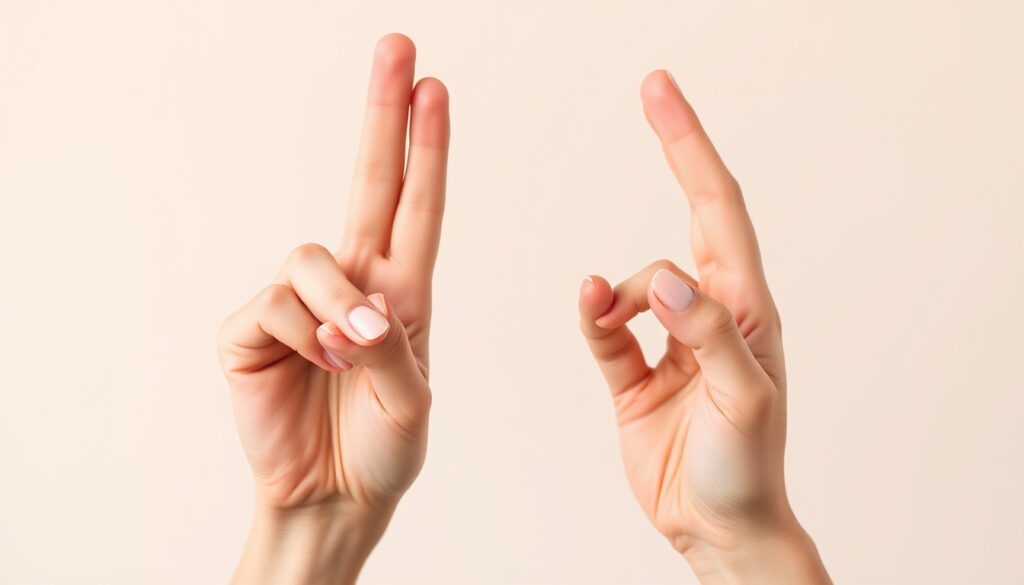
Thank You in Sign Language: ASL and BSL Guide
You’ve probably seen someone bring their hand to their chin and move it outward—and maybe you’ve wondered if that’s the same gesture everyone uses. The truth is, sign languages are as diverse as spoken ones, and the way you say “thank you” depends on where you are and which community you’re communicating with.
ASL sign for thank you: Open hand to chin, then outward ·
BSL sign for thank you: Flat hand from lips forward ·
Universal sign for thank you: No single universal gesture exists ·
I love you sign: Index, middle, and pinky extended ·
Sorry sign (ASL): Fist rotates over chest in circular motion ·
Excuse me sign (ASL): Open hand taps chest twice
Quick snapshot
- ASL thank you uses open hand from chin outward (Lifeprint (ASL dictionary))
- BSL thank you uses flat hand from lips outward (Twinkl (educational publisher))
- No universal sign for thank you exists (Lifeprint (ASL dictionary))
- Exact origin of specific hand shapes for thank you across cultures
- Precise adoption rates of baby sign language
- Early 1800s: Modern sign languages begin formal development
- 1960s: ASL recognized as a true language by linguists
- 2000s: Baby sign language becomes popular among hearing parents
- Growing online resources make learning sign language more accessible
- Regional variations continue to be documented by linguists
The snapshot above highlights the core contrasts. Here’s a closer look at the families and numbers behind them.
| Item | Value |
|---|---|
| ASL Sign Family | American Sign Language (used in US, Canada) |
| BSL Sign Family | British Sign Language (used in UK) |
| Number of Sign Languages | More than 300 distinct sign languages worldwide |
| Baby Sign | Thank you is among first signs taught to hearing toddlers |
The widespread number of sign languages means no single gesture works across borders, which is why learning the local form matters for clear communication.
How do I say thank you in sign language?
ASL thank you hand shape and motion
In American Sign Language, the standard “thank you” begins with your dominant hand flat, palm facing you, and fingertips near your lips. Then you move the hand forward and slightly downward toward the person you’re thanking. Lifeprint (respected ASL resource) describes this motion as similar to blowing a kiss, but directed at the recipient. The sign is typically aimed toward the other person, not straight down.
A beginner who aims the sign downward may accidentally produce the ASL sign for GOOD instead. Keep the direction toward the person to avoid confusion.
BSL thank you hand shape and motion
British Sign Language uses a different approach. Place the fingertips of an open hand (palm facing you) on your chin, then move the hand forward in a small arc. Twinkl (educational publisher) notes this as a beginner-friendly basic sign. Importantly, in BSL the same hand motion can mean both “please” and “thank you,” with the mouthed word and context clarifying the meaning.
Common mistakes when signing thank you
- Using the wrong directional angle: ASL’s THANK YOU points toward the recipient; GOOD points downward. Lifeprint (ASL dictionary) highlights this contrast.
- Forgetting that BSL “please” and “thank you” can share the same handshape. According to Evergreen Life (health & wellbeing publisher), the motion for both is placing fingertips on the chin and moving the hand away.
- Assuming one sign works everywhere. Sign languages are not universal—there are over 300 distinct sign languages globally.
The pattern: small directional and contextual cues carry big meaning. For a new learner, paying attention to hand placement and motion is more important than memorizing many signs at once.
Is there a universal sign for thank you?
Why sign languages vary by region
No single sign language exists everywhere. ASL, BSL, and Irish Sign Language (ISL) each evolved independently. Lifeprint (ASL dictionary) notes that ASL developed in the early 1800s from French Sign Language influences, while BSL has its own distinct history. More than 300 different sign languages are used around the world today.
Examples of thank you in ASL, BSL, ISL
- ASL: Flat hand from lips forward toward recipient.
- BSL: Flat hand from chin outward.
- ISL (Irish Sign Language): Open hand near mouth, moving forward like blowing a kiss.
What is I love you in sign language?
ASL I love you hand shape
The “I love you” sign in ASL combines the letters I, L, and Y: extend your thumb, index finger, and pinky while keeping the middle and ring fingers down. According to Lifeprint (ASL dictionary), this is one of the most recognized signs worldwide.
Differences between I love you and thank you signs
While both involve hand shapes near the face, they are distinct. “Thank you” uses a flat hand moving outward; “I love you” uses the three-finger configuration held stationary or slightly rotated. Beginners often confuse them because both can be directed at someone, but the hand shape is completely different.
The catch: using the wrong sign can change your message entirely. Practice each separately until the muscle memory sets in.
How do you sign sorry?
ASL sorry hand motion
The ASL sign for “sorry” uses a fist with the thumb resting on top. Rotate the fist in a circular motion over your chest. Lifeprint (ASL dictionary) describes this as a chest-level movement that conveys regret.
Relationship between sorry and please signs
“Please” in ASL uses a flat hand (palm facing chest) moving in a circle on the chest. The motion is similar to sorry but uses a different hand shape—flat versus fist. The difference is crucial: one is a request, the other an apology. New learners often mix them up because both involve chest circles.
Why this matters: mixing up “sorry” and “please” can be awkward in conversation. Drilling the hand shape (fist vs. flat) first helps avoid embarrassment.
How do you sign excuse me?
ASL excuse me hand motion
In ASL, “excuse me” is signed with an open hand (palm facing you) tapping your chest twice with the fingertips. Lifeprint (ASL dictionary) confirms this is the standard form used to get attention or apologize for a minor interruption.
Contexts for using excuse me
- Passing through a crowd.
- Getting someone’s attention politely.
- Apologizing for a small mistake (like bumping into someone).
“Excuse me” is more versatile than “sorry,” but its two taps make it easy to speed up and lose clarity. Slow and deliberate taps ensure understanding.
How to Learn Thank You in Sign Language: A Step-by-Step Guide for Beginners
- Choose your sign language. Decide whether you want to learn ASL (used in the US and Canada) or BSL (used in the UK). Stick with one initially to avoid confusion.
- Master the ASL “thank you” hand shape: Flat hand, palm toward you, fingertips near your lips. Move forward and slightly down toward the recipient. Practice 10 times daily. Watch the Lifeprint demonstration (ASL dictionary).
- For BSL “thank you”/“please”: Place fingertips on your chin, palm facing you, then move the hand forward. Repeat until the motion feels natural. Twinkl (educational resource) includes this in their beginner guide.
- Add facial expression. In both ASL and BSL, a sincere expression amplifies the sign. Smile and nod slightly when saying thank you.
- Test with a native signer. Join an online community or use video chat to get feedback. According to discussions on Reddit r/asl (learner community), directional feedback is the most common correction for beginners.
Confirmed facts
- ASL thank you uses open hand from chin outward (Lifeprint (ASL dictionary))
- BSL thank you uses flat hand from lips outward (Twinkl (educational publisher))
- No universal sign for thank you exists
What’s unclear
- Exact origin of specific hand shapes for thank you across cultures
- Precise adoption rates of baby sign language
The ASL sign for THANK YOU can look similar to the one-handed sign for GOOD, but they are not the same sign. THANK YOU is typically aimed more toward the person being thanked, while GOOD is angled more downward.
— Lifeprint (ASL dictionary)
In BSL, “thank you” uses an open hand with the palm facing you and the fingertips placed on the chin, then moved slightly down in a small arc. It’s a beginner-friendly basic sign.
— Twinkl (educational publisher)
The BSL sign for “please” and “thank you” is made by placing the fingertips of a flat hand on the chin and moving the hand down and away. The mouthed word distinguishes the meaning.
— Evergreen Life (health & wellbeing publisher)
For hearing parents teaching babies, the simplified version is often a single hand moving from chin to outward. A Facebook ASL group (community discussion) reports that many signers use a thumbs-up or “no problem” after receiving thanks, which is a natural conversational flow.
The pattern across all sources: sign language learning is most effective when you combine hand shape, direction, and facial expression. Relying on just one element leads to confusion.
facebook.com, youtube.com, wikihow.com, tiktok.com, tiktok.com, tiktok.com, youtube.com
For those learning British Sign Language, understanding how to express gratitude is just one part of the journey, and you can also explore BSL accessibility for driving tests to see how BSL is used in practical settings.
Frequently asked questions
How long does it take to learn basic sign language?
With regular practice, most beginners can learn the alphabet and 10–20 polite signs within a few weeks. Mastering conversational flow takes several months.
Can I use ASL in the United Kingdom?
ASL and BSL are different languages. Using ASL in the UK will not be understood by most Deaf BSL users. Learn the local sign language.
Is sign language the same everywhere?
No. There are over 300 distinct sign languages worldwide, each with its own grammar and vocabulary.
What is the difference between ASL and BSL?
ASL uses one hand for most signs; BSL uses two hands. The alphabets are also completely different. Even the sign for “thank you” varies in hand placement and motion.
How do I teach my baby thank you in sign language?
Model the sign consistently during mealtime or when receiving a toy. Simplify the motion: a flat hand moving from the chin outward. Use praise when the baby attempts the sign.
Are there emojis for thank you in sign language?
No standard emoji represents the thank-you sign. The “prayer hands” emoji 🙏 is sometimes used colloquially, but it does not depict the actual gesture.
For related language and learning guides, explore Translate German to English and Best Workout Routines for Beginners.
More related posts
 Dodgers vs Toronto Blue Jays Match Player Stats: Game 4
 Topamax Ruined My Life? Side Effects & Withdrawal Guide
 9-1-2001: 9/11 Attacks – Youngest Victim & Survivors
 Ripley’s Aquarium of Myrtle Beach: Tickets, Hours, & Tips
 Aquarium of the Pacific: Visit Tips, Hours & Exhibits
 The Substance: Where to Watch Streaming & Rental Guide
 Reheat Pizza in Air Fryer – No More Soggy Slices
 What Time Does Walmart Pharmacy Close? Hours & Phone