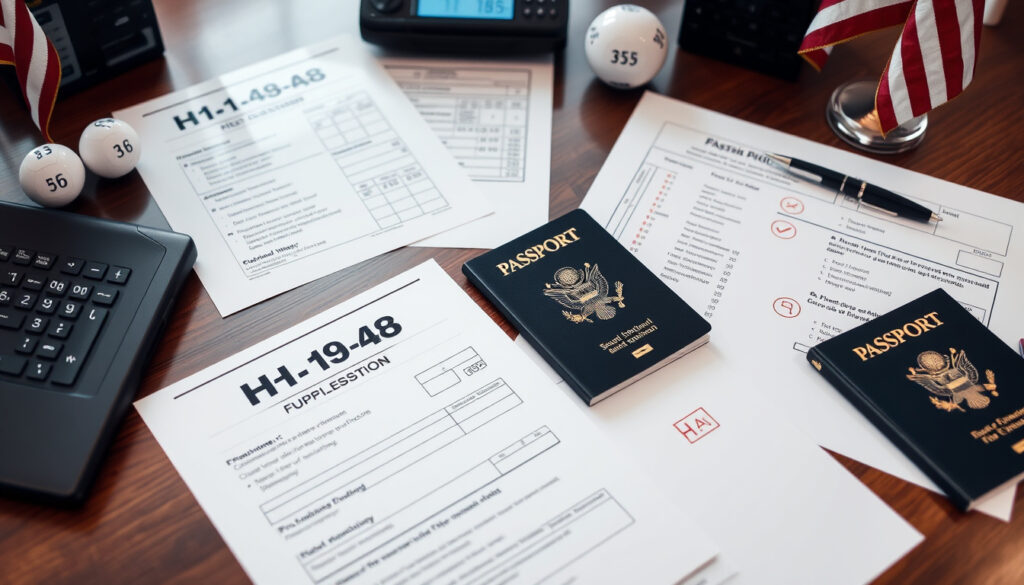
H-1B Visa Guide: Eligibility, Costs, Lottery & Application
The H-1B visa remains the dominant pathway for U.S. employers to recruit specialized foreign talent, yet its fee structure and lottery mechanics change dramatically from year to year. For FY2027, the program introduces a wage-weighted selection system, a $215 registration fee (up from $10), and a $100,000 fee for certain overseas beneficiaries—making accurate information essential for employers and workers alike.
Visa Type: Nonimmigrant classification · Purpose: Specialty occupations · Sponsor Required: U.S. employers · Services Covered: Exceptional merit and ability · Key Agencies: USCIS, DOL
Quick snapshot
- FY2027 registration opens March 4, 2026 (Migrate Mate)
- Wage-weighted lottery effective Feb 27, 2026 (Migrate Mate)
- First wage-weighted H-1B cap season (Migrate Mate)
- Higher earners get more lottery entries (Migrate Mate)
Six key facts about the H-1B program, drawn from official and specialist sources.
| Field | Value |
|---|---|
| Full Form | Temporary specialty occupation worker visa |
| Administered By | USCIS and DOL |
| Key Requirement | Employer petition |
| Notable Fee | $100,000 in clarified cases |
| FY2027 Cap | 65,000 regular + 20,000 master’s |
| FY2027 Registration Opens | March 4, 2026 |
What does H-1B visa mean?
The H-1B is a nonimmigrant visa classification that lets U.S. employers hire foreign workers in specialty occupations — roles requiring at least a bachelor’s degree or equivalent in a specialized field. The term covers everything from software engineering and pharmaceutical research to finance and advanced medicine.
H-1B Program Overview
According to the Department of Labor, the H-1B program exists to let American companies access global talent for jobs that demand theoretical or technical expertise and specialized knowledge. It’s not a pathway to permanent residency — it’s a temporary work authorization tied to a specific employer and position.
Specialty Occupations Defined
USCIS defines a specialty occupation as one requiring:
- A bachelor’s degree or higher in a specific field, OR its equivalent in work experience
- The degree must be normal for the occupation in the U.S. industry
- The job must involve complex or unique duties requiring specialized knowledge
Typical qualifying fields include computer science, medicine, engineering, architecture, and mathematics. Fashion models of distinguished merit and ability also qualify under a separate H-1B category.
The implication: if a role doesn’t normally require a four-year degree in the U.S. market, it’s unlikely to pass H-1B scrutiny — regardless of how specialized the actual work might be.
Who qualifies for an H-1B visa?
Eligibility flows in two directions: the worker must meet qualification thresholds, and the employer must complete specific filing steps.
Eligibility Criteria
Qualified workers fall into several categories:
- Professionals with bachelor’s degrees or higher in fields like IT, medicine, engineering, finance, or sciences
- Individuals with exceptional ability in sciences, arts, or business (less common)
- Fashion models of distinguished merit and ability
Employer Requirements
The U.S. employer must:
- File Form I-129 (Petition for a Nonimmigrant Worker) with USCIS
- Demonstrate the position requires a bachelor’s degree or higher
- Prove the foreign worker has the required qualifications
- File a Labor Condition Application (LCA) with the Department of Labor certifying that the wage meets the prevailing wage for the occupation in the area of employment
The catch: employers cannot use the H-1B to fill positions where the normal route to qualification is a degree, but the industry has historically hired without one. Each petition gets scrutinized against industry norms.
How long can I stay in the U.S. with an H-1B visa?
The H-1B is a temporary classification with hard limits on duration.
Initial Period
Most H-1B petitions are approved for an initial stay of up to three years. This gives the employer time to complete the project, season the hire, or assess long-term fit.
Extensions
Extensions are available in up to three-year increments, but the total maximum stay is six years. After that point, the worker generally must either leave the U.S. for at least one year before seeking a new H-1B, or have an approved permanent residence application in the queue.
Workers with approved employment-based green card applications filed before the fourth year of H-1B status may qualify for one-year extensions beyond the six-year cap under a provision called AC21.
The implication: the H-1B is explicitly a temporary visa, not a gray-card staging ground. Workers who want to stay permanently eventually need a different immigration pathway.
How much does a H-1B visa cost now?
FY2027 brings significant changes to the fee structure, including the first major registration fee increase in years and a new $100,000 payment triggered by a presidential proclamation.
Standard Fees
Below is the complete fee breakdown employers face when sponsoring an H-1B petition in FY2027.
- Registration fee: $215 per beneficiary for FY2027 (Ellis, immigration services firm), up from $10 in prior years
- Form I-129 base filing: $460 for small employers (25 or fewer workers), $780 for larger ones (Ellis)
- ACWIA training fee: $750 for small employers, $1,500 for larger employers (Cornell Law School)
- Fraud Prevention and Detection fee: $500 for initial petitions and certain transfers (Ellis)
- Asylum Program fee: $300 for small employers, $600 for larger employers (Ellis)
For applicants consular processing outside the U.S., the DS-160 nonimmigrant visa application fee adds $185 (Cornell Law School). Some H-1B and L-1 blanket petitions also trigger an additional $4,500 Public Law 114-113 fee at U.S. consulates (U.S. Department of State).
$100,000 Fee Details
A Presidential Proclamation titled “Restriction on Entry of Certain Nonimmigrant Workers” was issued September 19, 2025, and took effect September 21, 2025 (Gozel Law, immigration law firm). The $100,000 payment applies to cap-subject H-1B petitions filed for beneficiaries outside the United States. According to Baker Law, most F-1 students transitioning to H-1B and individuals with previously issued valid H-1B visas are exempt from this requirement.
Gozel Law notes that the $215 registration amount is a serious budget item for employers who plan to register many candidates — it’s non-refundable even if the petition isn’t selected in the lottery.
The $100,000 fee doesn’t apply to H-1B extensions or transfers with the same employer, only new cap-subject petitions for overseas beneficiaries. Exemptions cover most F-1 OPT/STEM OPT holders who were in valid status.
Who pays the $100,000 for H-1B?
The fee landscape for H-1B has always been employer-funded for standard filing, with one notable exception.
Fee Payer Responsibilities
Standard H-1B filing fees — the I-129 base filing, ACWIA training fee, fraud prevention fee, and asylum program fee — are paid by the petitioning employer. Ellis, an immigration services firm, confirms that premium processing is the only fee that may legally be paid by the employee, provided it doesn’t violate wage requirements.
Attorney fees for H-1B petitions typically run $3,000 to $7,500 depending on employer size and whether premium processing is used (Peter Chu). Total employer costs can range from $4,720 to over $17,000 including legal representation, according to estimates from Peter Chu.
Recent Clarifications
For FY2027, employers must include the DOL Occupational Employment and Wage Statistics (OEWS) wage level, Standard Occupational Classification (SOC) code, and work location city in all registrations. This data feeds directly into the new wage-weighted selection system. For more information on the H-1B visa, please visit economia spaziale italiana.
The implication: companies hiring entry-level foreign workers will find those candidates at a structural disadvantage in the FY2027 lottery compared to hires already earning above median wages for their occupation and location.
How the H-1B lottery works in FY2027
The H-1B program operates under an annual cap: 65,000 regular visas plus an additional 20,000 reserved for beneficiaries with a U.S. master’s degree or higher (Migrate Mate). FY2027 registration opens March 4, 2026 at noon ET and closes March 19, 2026 at noon ET.
Wage-Weighted Selection System
A DHS final rule announced December 23, 2025, effective February 27, 2026, fundamentally changes how selections work (Migrate Mate). Instead of equal-chance random selection, the lottery is now weighted by the OEWS wage level in the registration:
- Level IV (top 17% of wages): 4 lottery entries
- Level III (34th–50th percentile): 3 lottery entries
- Level II (17th–33rd percentile): 2 lottery entries
- Level I (bottom 34%): 1 lottery entry
According to Migrate Mate, this means the top third of registrations by wage will receive roughly 57% of all lottery entries, while the bottom third gets only 14%. Only one registration per beneficiary per fiscal year per petitioner is allowed — duplicates are invalidated.
The wage-weighted approach rewards seniority but creates a catch-22: international students entering the job market fresh from graduate programs will compete for the same single-entry slots as lower-wage workers, making it harder for new graduates to get selected even when they’re genuinely qualified.
How to apply for an H-1B visa: step by step
The H-1B process runs through several stages, with the lottery as the first gate for most applicants.
-
Step 1 — Determine eligibility: The employer confirms the position qualifies as a specialty occupation and that the foreign worker holds the required degree or equivalent experience. The employer then files a Labor Condition Application (LCA) with the Department of Labor, which requires attesting to paying the prevailing wage and working conditions.
-
Step 2 — Register in the lottery: For cap-subject petitions, the employer (or their attorney) submits electronic registrations during the FY2027 window, March 4–19, 2026. Each registration costs $215 and must include the beneficiary’s passport details, DOL OEWS wage level, SOC code, and work location. Duplicate registrations are invalidated. The registration fee is non-refundable regardless of selection outcome.
-
Step 3 — File Form I-129: If selected in the lottery, the employer has 90 days to file Form I-129 with USCIS. Standard filing fees run $460–$780 depending on employer size, plus $750–$1,500 ACWIA training fees, $500 fraud prevention fees, and $300–$600 asylum program fees. Optional premium processing (guarantees 15 business day action) costs $2,965 for petitions filed on or after March 1, 2026.
-
Step 4 — Wait and activate: USCIS adjudicates the petition. Approved cases receive Form I-797 notice. Foreign workers already in the U.S. can change status; those overseas must apply for an H-1B visa at a U.S. consulate, paying the $185 DS-160 fee and potentially the $4,500 consular Public Law 114-113 fee.
What we know for certain
- H-1B is a nonimmigrant visa for U.S. employer sponsorship
- Requires specialty occupation with bachelor’s degree minimum
- FY2027 registration fee is $215 (non-refundable)
- Wage-weighted lottery applies starting FY2027
- $100,000 fee effective September 21, 2025 for overseas beneficiaries
- Premium processing fee increased to $2,965 on March 1, 2026
What remains uncertain
- Exact implementation of $100,000 fee for some employer configurations
- How regional variations affect processing at different consulates
- Whether legal challenges affect the wage-weighted rule before March 2026
The $215 amount is a serious budget item for employers who plan to register many candidates. It’s non-refundable regardless of selection.
— Gozel Law (immigration law firm) on FY2027 registration fee changes
This is the most significant structural change to the H-1B cap process in decades. The shift from random lottery to wage-weighted selection fundamentally alters the math for international graduates.
— Migrate Mate (immigration guide) on the FY2027 selection system
Related reading: W-9 Form · Full Time Jobs
Beyond standard H-1B costs like the hefty registration fee, applicants face new requirements such as the Visa Integrity Fee for nonimmigrant visa stamps abroad.
Frequently asked questions
What is H1B visa full form?
H-1B stands for “temporary specialty occupation worker.” It’s a nonimmigrant visa category that lets U.S. employers hire foreign professionals in roles requiring at least a bachelor’s degree or equivalent specialized knowledge.
What is H-1B visa program?
The H-1B program is a U.S. immigration pathway administered by USCIS and the Department of Labor that allows American companies to employ foreign workers in specialty occupations. It operates under an annual cap of 65,000 regular visas plus 20,000 for U.S. master’s degree holders.
What are H1B visa requirements?
Requirements include: a job offer in a specialty occupation, a bachelor’s degree or higher in the relevant field (or equivalent experience), and an employer willing to file Form I-129 with USCIS and a Labor Condition Application with DOL. The employer must also pay applicable filing fees.
What is H1B visa lottery?
The H-1B lottery is the selection process used when cap-subject registrations exceed available visas. For FY2027, USCIS moved to a wage-weighted system where beneficiaries at higher DOL wage levels receive multiple lottery entries (up to 4), while entry-level workers receive just one.
Is H-1B equal to green card?
No. H-1B is a temporary nonimmigrant visa tied to a specific employer and position. A green card (permanent residence) allows unlimited stay and work authorization independent of any employer. Some H-1B holders pursue employment-based green cards, but H-1B status itself does not grant permanent residency.
What’s the hardest US visa to get?
The EB-1 (extraordinary ability) and EB-5 (investor) categories are extremely selective. For employment-based routes, the H-1B is comparatively accessible because it doesn’t require extraordinary achievement — only a bachelor’s degree and employer sponsorship. The difficulty lies in the lottery, not the qualification standard.
What are H-1B visa rules 2025?
Key 2025 changes include: a presidential proclamation (September 19, 2025) imposing a $100,000 fee on certain cap-subject petitions for overseas beneficiaries, DHS NPRM for wage-weighted lottery (September 24, 2025), and the final rule announcement (December 23, 2025) effective February 27, 2026.
For recent graduates and entry-level international talent competing for H-1B slots, the FY2027 shift to wage-weighted selection changes the calculus significantly. Employers paying above-median wages get more lottery entries — which means companies choosing to hire international graduates at competitive, market-rate compensation will find those candidates have better odds than they did under the random lottery. The tradeoff is real: experienced engineers get a boost, but fresh STEM graduates face structural headwinds. Workers in this position should ask prospective employers directly about their H-1B strategy and whether they’ll register candidates at wage levels that maximize lottery entries.
More related posts
 All Barbie Movies in Order: Complete List (2001–2022)
 What Does Strep Throat Look Like? Vs Sore Throat Symptoms
 NFL Playoff Schedule 2024 – Full Results, Bracket and Recap
 Amon-Ra St. Brown – Stats, Bio, Family and Contract
 Another Word for Significant: 230+ Synonyms & Alternatives
 A Quiet Place 2: Guide, Ca t, and Sequel New
 Tom Segura Garth Brooks Theory: The Viral Conspiracy Explained
 Goodwill Bins Near Me: How to Find & Shop Outlets