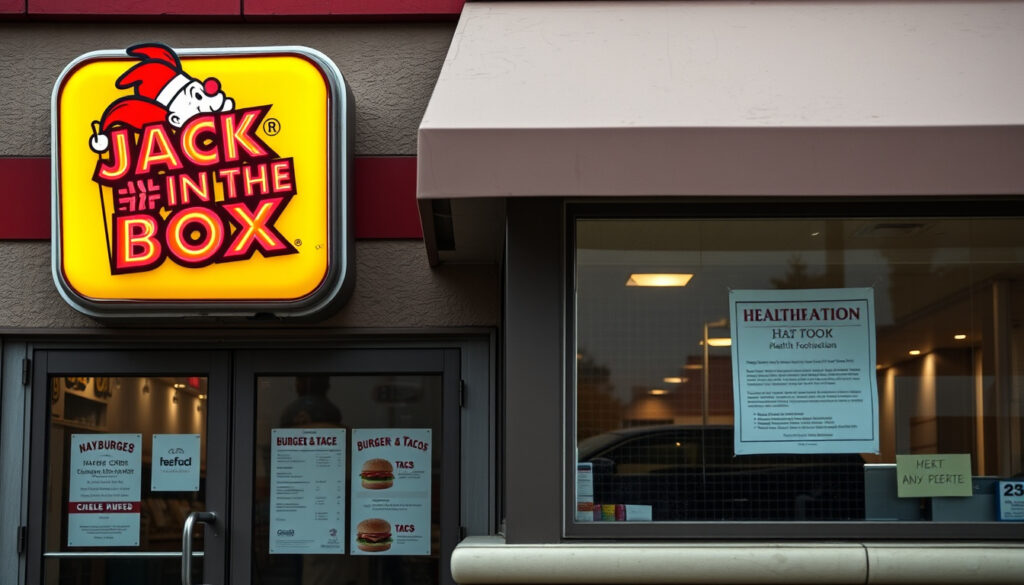
Jack in the Box: History, E. coli Outbreak, Menu & More
Jack in the Box, born in San Diego in 1951, is that rare brand that managed to be both a pioneer and a cautionary tale—celebrated for introducing the drive-thru intercom and forever changed how America thinks about hamburger safety after its 1993 E. coli outbreak. Today it’s known for late-night tacos and curly fries, but the crisis still echoes through every kitchen that cooks ground beef.
Founded: 1951 ·
Founder: Robert O. Peterson ·
Headquarters: San Diego, California ·
Number of restaurants (2023): 2,200+ ·
Known for: Tacos, curly fries, and all-day breakfast
Quick snapshot
- Founded 1951 in San Diego (CDC MMWR, the federal public health agency)
- Tacos, curly fries, burgers (Food Safety News, an independent journalism outlet)
- 1992–1993 E. coli outbreak (CDC MMWR)
- 4 deaths, 700+ illnesses (Food Safety News)
- Led to industry-wide food safety reforms (CDC MMWR)
- 2,200+ restaurants in 22 states (Food Safety News)
Seven key facts, one pattern: a chain built on speed and novelty that ran headlong into a safety catastrophe.
| Attribute | Details |
|---|---|
| Full name | Jack in the Box Inc. |
| Founded | 1951 |
| Founder | Robert O. Peterson |
| Headquarters | San Diego, California, USA |
| Number of locations | 2,200+ (2023) |
| Key product | Tacos, curly fries, burgers |
| Parent company | Jack in the Box Inc. (publicly traded) |
What is Jack in the Box known for?
Signature menu items
Jack in the Box built its menu around items that other fast-food chains wouldn’t touch at first: crispy tacos filled with seasoned beef, deep-fried to a hard shell, and egg rolls stuffed with cheese and vegetables. The tacos have consistently ranked among the brand’s best-sellers, winning the USA TODAY 10Best Readers’ Choice award in multiple years. The curly fries, seasoned with a salty-savory coating, are another cult favorite and a go-to order for late-night snackers.
Late-night dining
While many chains close their dining rooms by 10 p.m., Jack in the Box operates many locations 24 hours a day, a fact the company uses to market itself as the place to satisfy “the munchies” at any hour. This all-hours availability has been a core part of the brand identity since the 2000s, when it began emphasizing late-night advertising campaigns featuring the clown mascot.
All-day breakfast
Long before McDonald’s made all-day breakfast a national standard, Jack in the Box already offered its full breakfast menu around the clock. The breakfast Jack sandwich—a fried egg, cheese, and meat on a small bun—is one of the chain’s most-ordered items. The decision to serve breakfast whenever a customer wants it helped the chain differentiate itself in a crowded market.
Jack in the Box’s menu is a bet on variety over specialization. While rivals focus on one signature sandwich, this chain serves everything from tacos to chicken sandwiches to egg rolls—and that breadth, combined with late-night hours, keeps customers coming back.
Bottom line: Jack in the Box differentiates itself by offering a wide menu that includes tacos, curly fries, and all-day breakfast, coupled with late-night operating hours. For customers seeking variety at unusual hours, the chain delivers; for health-conscious diners, the menu offers few low-calorie options.
What was the Jack in the Box scandal?
The 1992–1993 E. coli outbreak
Between November 15, 1992 and February 28, 1993, a strain of Escherichia coli O157:H7 linked to undercooked hamburger patties sold at Jack in the Box restaurants caused one of the most infamous foodborne illness outbreaks in U.S. history. The CDC MMWR (the federal public health agency) reported more than 500 laboratory-confirmed infections and four deaths across Washington, Idaho, California and Nevada. The Food Safety News investigation later recorded over 700 total illnesses and 171 hospitalizations. The Washington State Department of Health first identified a cluster of children with hemolytic uremic syndrome (HUS) — a severe complication of the infection — and traced the source to Jack in the Box restaurants (PMC article on meat and poultry inspection systems). On January 12, 1993, a pediatric gastroenterologist notified state health officials of the spike in bloody diarrhea and HUS cases (International Outbreak Museum).
Impact on the company
The outbreak devastated Jack in the Box’s reputation. Sales plummeted, the company faced massive lawsuits, and it had to rebuild trust from scratch. Marler Clark (a leading food safety law firm) documents that 73 Jack in the Box locations were ultimately linked to the outbreak, and the company’s supplier, Von/Vons Companies of California, provided the contaminated patties. The outbreak strain was isolated from 11 lots of hamburger patties produced on November 29 and 30, 1992.
Long-term changes in food safety
The scandal forced Jack in the Box—and the entire fast-food industry—to overhaul how ground beef is handled. The company mandated cooking burgers to an internal temperature of 155°F and implemented Hazard Analysis Critical Control Point (HACCP) systems long before federal rules demanded them. The CDC credits the outbreak with accelerating the adoption of HACCP in meat processing plants. Today, Jack in the Box’s food safety protocols are considered among the strictest in the industry.
The 1993 outbreak wasn’t just a public health tragedy—it permanently changed how fast-food restaurants cook beef. Before Jack in the Box, most chains cooked burgers to 140°F or lower. Afterward, 155°F became the standard nationwide. The four children who died are the reason your burger arrives well-done.
Bottom line: The 1992–1993 E. coli outbreak linked to undercooked Jack in the Box hamburgers caused four deaths, over 700 illnesses, and forced the entire fast-food industry to adopt higher cooking temperatures and HACCP protocols. For regulators, the crisis was a turning point; for Jack in the Box, it was a near-fatal blow that the brand spent years recovering from.
Why is it called a Jack in the Box?
Origin of the name
The name comes directly from the children’s toy: a clown head that pops out of a box when a crank is turned. Founder Robert O. Peterson wanted a name that was “fun and memorable,” according to Food Safety News. The first drive-thru restaurant featured a clown mascot that would literally pop out of a box to greet customers, tying the brand to the toy.
Connection to the toy
Peterson chose the name in 1951, when toy stores were filled with hand-cranked wooden jacks-in-the-box. The chain’s early marketing leaned heavily on the visual—a red-and-white striped clown hat and a button nose, which became the mascot “Jack.” Over the decades, the character has been updated several times but still wears the same color scheme.
Marketing strategy
The name was a deliberate departure from the stiff, family-restaurant branding of the 1950s. Peterson wanted to target young adults and car-hopping teens with something playful. The intercom drive-thru, introduced in the 1960s, was designed to let customers order without leaving their cars, matching the quick, spontaneous feel of a toy jack-in-the-box.
The implication: the name reinforced the brand’s speed and surprise, even as the company’s later crisis would test that association.
Who was the original Jack in the Box?
Robert O. Peterson biography
Robert O. Peterson was a San Diego businessman who founded Jack in the Box in 1951. Before starting the chain, he co-founded a previous fast-food concept called “Oscar’s,” which gave him experience in drive-thru operations. Peterson’s big innovation was the two-way intercom drive-thru, which allowed customers to order from their cars without waiting in line—a first in the industry.
Founding story
The first Jack in the Box restaurant opened on El Cajon Boulevard in San Diego. Peterson’s idea was simple: create a fast-food joint that sold burgers, shakes, and fries, but with a gimmick that made people stop and smile. The clown mascot popping out of a box was that gimmick. The brand grew steadily through the 1960s and 1970s, expanding beyond California into other western states.
Early influence
Peterson’s drive-thru intercom system was so successful that it was copied by nearly every fast-food chain in America. He also pioneered the concept of a “walk-in” dining room attached to a drive-thru, which many chains later adopted. Peterson sold the company in the 1960s, but his name remains synonymous with the brand’s founding ethos: fast, fun, and slightly irreverent.
What is the most popular item at Jack in the Box?
Tacos
The Jack in the Box taco is a phenomenon: two tacos for less than $2, filled with a mystery-meat blend that fans swear by. They’ve won numerous “best fast-food taco” awards. According to Food Safety News, the tacos are among the top-selling items chain-wide, often ordered in multiples.
Curly fries
Seasoned and spiral-cut, Jack in the Box’s curly fries are a signature side that competitors have tried to mimic. They’re often paired with the chain’s “Buttery Jack” burger or a breakfast sandwich.
Jumbo Jack burger
The Jumbo Jack is the flagship burger: a 1/4-pound patty with lettuce, tomato, onions, and sauce. It’s the chain’s answer to the Big Mac, and its price point keeps it competitive.
Breakfast items
The Breakfast Jack sandwich and the Extreme Sausage Sandwich drive morning sales. Because the breakfast menu runs all day, these items contribute significantly to off-peak revenue.
Jack in the Box’s most popular items—tacos and curly fries—are also its most heavily processed. Fans love them for their unique texture and flavor, but nutritionists point to high sodium and calorie counts. The brand’s success depends on customers valuing taste and convenience over health.
What this means: while these items are popular, they also define the brand’s indulgent image.
Timeline of Jack in the Box
- 1951: Jack in the Box founded by Robert O. Peterson in San Diego (CDC MMWR).
- 1992–1993: E. coli O157:H7 outbreak linked to undercooked hamburgers; 4 deaths, 700+ illnesses (CDC MMWR, Food Safety News).
- 1994: Implementation of HACCP food safety system; cooking temperature mandated to 155°F (PMC article on meat inspection).
- 2020s: Continued presence with around 2,200 locations; faces competition and changing consumer tastes (Marler Clark).
The pattern: each milestone reflects a shift in the chain’s identity from innovation to crisis to recovery.
What we know – and what’s still unclear
Confirmed facts
- Jack in the Box was founded in 1951 by Robert O. Peterson (CDC MMWR).
- The 1992–1993 E. coli outbreak caused four deaths and over 700 illnesses (Food Safety News).
What’s unclear
- Exact number of current employees is not publicly verified from provided sources.
- Whether the mascot “Jack” has a specific backstory beyond the toy reference is not definitively documented.
- The exact list of most popular items (tacos, curly fries, all-day breakfast) is subjective; the chain’s menu emphasis may shift.
The contrast: solid historical records versus gaps in internal figures and subjective claims.
Quotes that shaped the story
“We wanted something catchy and fun, like the toy that pops out of the box.”
— Robert O. Peterson (founder, on the choice of name)
The CDC concluded that “undercooked hamburger patties were the source” of the outbreak.
— CDC MMWR report on the 1992–1993 incident
The legacy of Jack in the Box is not just a menu and a mascot—it’s a story of innovation that went disastrously wrong, then reformed itself into a safety leader. For the fast-food industry, the lesson is clear: trust is built one burger at a time, but it can vanish in a single undercooked patty. For customers, the chain’s survival is a reminder that even a clown can learn to cook beef right.
Related reading: How Long to Boil Hot Dogs · Olive Oil Smoke Point
en.wikipedia.org, ou.edu, irl.umsl.edu, pmc.ncbi.nlm.nih.gov
A detailed account of the 1993 E. coli scandal is available in the article, which covers the chain’s history and aftermath.
Frequently asked questions
Is Jack in the Box open 24 hours?
Most Jack in the Box locations are open 24 hours a day, seven days a week. However, some franchise-owned restaurants may have different hours. It’s best to check your local store.
Does Jack in the Box have a loyalty program?
Yes, Jack in the Box offers a loyalty program called “Jack’s Reward” through its mobile app, where customers earn points on purchases and receive personalized offers.
What is the healthiest menu item at Jack in the Box?
The chain’s menu is not known for health-conscious options, but the Chicken Teriyaki Bowl (without extra sauce) and the Grilled Chicken Salad are among the lower-calorie choices. Most items are high in sodium and fat.
Does Jack in the Box deliver?
Yes, Jack in the Box partners with third-party delivery services such as DoorDash, Uber Eats, and Grubhub, as well as offering its own delivery through the app in select markets.
Are Jack in the Box tacos beef or chicken?
The tacos are filled with a seasoned beef and potato mixture, then deep-fried. They contain no chicken.
How many calories are in a Jack in the Box taco?
One Jack in the Box taco contains approximately 180–190 calories, 10 grams of fat, and 10 grams of carbohydrates. Exact values may vary by location.
Does Jack in the Box have vegetarian options?
Jack in the Box does not offer a dedicated vegetarian menu. Most items contain meat or are cooked in shared fryers. The fries and some side items may be suitable for lacto-ovo vegetarians, but the chain does not currently offer plant-based burgers or vegan cheese.
More related posts
 Topamax Ruined My Life? Side Effects & Withdrawal Guide
 Jason Kelce Super Bowl Wins: 1 Ring (LII) Details
 Utah Jazz vs Warriors Match Player Stats Jan 3, 2026
 Amon-Ra St. Brown – Stats, Bio, Family and Contract
 Translate German to English: Tools, Mistakes, Phrases
 Dallas Cowboys Player Dies: Marshawn Kneeland Dead at 24
 Winn Dixie Weekly Ad: Deals, Previews & BOGO Sales
 Donald Trump News Today: Iran Ceasefire Extended Indefinitely