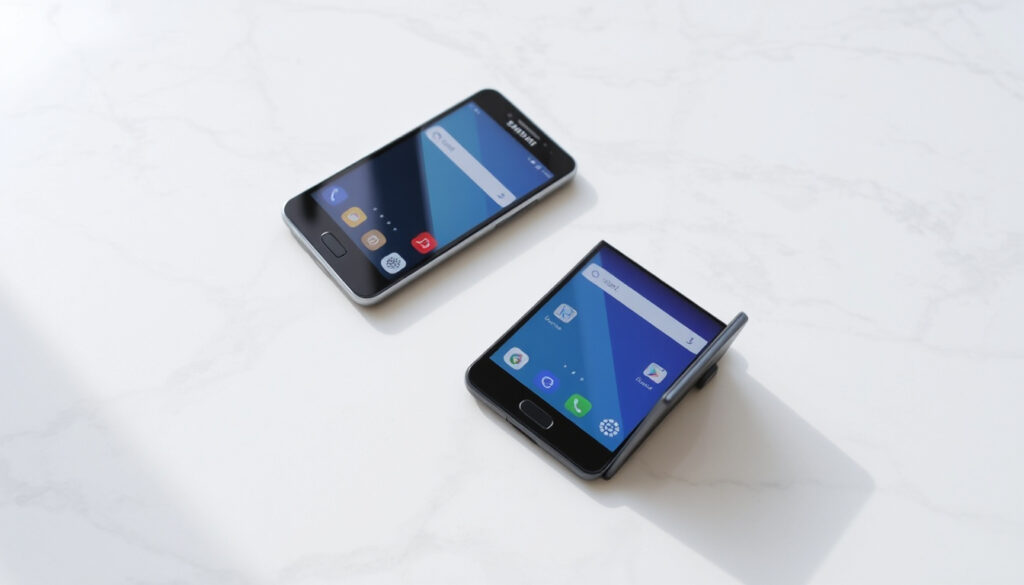
Galaxy Z Flip 7 Review: Worth It? Price, Specs & Disadvantages
There’s a particular thrill in pulling a phone out of your pocket and flipping it open, and Samsung’s latest clamshell leans into that feeling harder than ever with the Galaxy Z Flip 7, which landed in July 2025 with a bigger 6.9-inch foldable display and the new Exynos 2500 chipset, aiming to fix the compromises that held earlier foldables back. For anyone wondering whether this iteration finally makes the flip phone a practical daily driver, the real answer lives in the trade-offs between price, durability, and day-to-day usability.
Display size (main): 6.9 inches ·
Processor: Exynos 2500 ·
Battery capacity: 4300 mAh ·
RAM: 12 GB ·
Storage options: 256 GB / 512 GB
Quick snapshot
- 6.9-inch main AMOLED display (T-Mobile (US carrier specs))
- Exynos 2500 chipset (PhoneArena (specialist mobile reviewer))
- 4300 mAh battery (T-Mobile)
- Official unsubsidized retail price not confirmed on Samsung’s site
- Camera sensor specifications not detailed in top-tier sources
- Water resistance rating beyond IP48 not widely documented
- July 2025: Galaxy Z Flip7 announced and released (PhoneArena)
- 2024: Galaxy Z Flip6 launched at $1,100 (Gizmodo (tech editorial outlet))
- Carrier contract availability across Ireland and Europe expanding
- Galaxy AI features likely to receive software updates through 2026
The specs paint a familiar picture: the Z Flip 7 is an iterative upgrade rather than a reinvention. Here’s how the headline numbers stack up.
| Specification | Galaxy Z Flip 7 |
|---|---|
| Display | 6.9-inch foldable AMOLED |
| Chipset | Exynos 2500 |
| RAM | 12 GB |
| Storage | 256 GB / 512 GB |
| Battery | 4300 mAh |
| Release date | July 2025 |
| Price (Ireland contract) | €299 upfront on €65/month plan (Three) |
| Cover display | 4.1-inch (1048 × 948) |
| Water resistance | IP48 |
Irish buyers face a split market: the Flip 7 is available SIM-unlocked from import retailers like Gomibo.ie for around €880, or on a Three Ireland contract at €299 upfront with a €65 monthly plan. The contract route effectively spreads the cost but locks you in for two years.
Is the Galaxy Z Flip7 worth it?
Key strengths of the Galaxy Z Flip7
- The 6.9-inch main display is noticeably larger than the Flip 6’s 6.7-inch panel, giving more room for media and multitasking (T‑Mobile).
- 12 GB of RAM ensures smooth performance across apps and Galaxy AI features (PhoneArena).
- The bigger 4.1-inch cover screen with higher resolution (1048 × 948 vs 720 × 748) makes quick interactions like notifications and widgets genuinely useful (PhoneArena).
Main drawbacks to consider
- The 4300 mAh battery trails flagship slab phones, which often pack 5000 mAh or more.
- Foldable screens remain more fragile than traditional glass; the IP48 rating means some dust protection but limited water resistance (Gomibo.ie).
- Repair costs for the foldable display can run significantly higher than a standard phone screen.
The implication: this phone rewards those who value the folding form factor enough to accept its limits.
Samsung traded absolute battery capacity for the foldable form factor. At 4300 mAh, the Flip 7 sits 14% below the Galaxy S25 Ultra’s 5000 mAh cell — a gap that shows up in real-world usage, especially on heavy camera or gaming days.
What is the difference between Samsung Z Flip 7 and Flip 6?
Design and display changes
- The Flip 7’s main display grows to 6.9 inches from 6.7 inches on the Flip 6 (T‑Mobile).
- The cover screen jumps from 3.4 inches to 4.1 inches, with a sharper 1048 × 948 resolution (PhoneArena).
- Both phones have an adaptive 1–120 Hz refresh rate on the main display (OtoFly).
Processor and performance upgrades
- Flip 7 runs on the Exynos 2500; Flip 6 used Snapdragon 8 Gen 3 (PhoneArena).
- RAM stays at 12 GB on both models.
- Storage options (256 GB and 512 GB) remain the same.
Battery and camera improvements
- Battery capacity increases to 4300 mAh from 4000 mAh — a 7.5% gain (T‑Mobile).
- Camera sensor details for the Flip 7 are not confirmed in top-tier sources, though Samsung’s product page highlights AI-enhanced processing in Flex Mode.
The differences between generations, distilled into a side-by-side comparison.
| Feature | Galaxy Z Flip 7 | Galaxy Z Flip 6 |
|---|---|---|
| Main display | 6.9-inch AMOLED | 6.7-inch AMOLED |
| Cover display | 4.1-inch (1048 × 948) | 3.4-inch (720 × 748) |
| Chipset | Exynos 2500 | Snapdragon 8 Gen 3 |
| RAM | 12 GB | 12 GB |
| Battery | 4300 mAh | 4000 mAh |
| Storage | 256 / 512 GB | 256 / 512 GB |
| Refresh rate | 1–120 Hz adaptive | 1–120 Hz adaptive |
| Release year | 2025 | 2024 |
The pattern: the Flip 7 delivers meaningful display and battery upgrades, but keeps RAM and storage identical. The chipset swap from Snapdragon to Exynos is the biggest unknown for performance enthusiasts.
The Exynos 2500’s real-world efficiency hasn’t been benchmarked head-to-head against the Snapdragon 8 Gen 3 on Irish networks yet. If you’re upgrading from the Flip 6, the cover screen and battery gains are tangible — but the chipset change introduces uncertainty for raw performance.
The catch: the chipset swap may matter most to those who push performance limits.
How much will the Galaxy Z Flip7 cost?
Retail pricing and carrier deals in Ireland
- SIM-unlocked pricing from Gomibo.ie, a German-based retailer serving the Irish market, lists the Galaxy Z Flip 7 at €880 (Gomibo.ie).
- Three Ireland offers the 256 GB model for €299 upfront on a €65 per month contract.
- Verizon carries the smartphone in the US, though exact unsubsidized pricing wasn’t confirmed on top SERP results.
Contract vs. pay-as-you-go options
- The Three Ireland contract route totals €299 + (24 × €65) = €1,859 over two years, covering the phone and a service plan.
- Buying unlocked from Gomibo.ie at €880 gives you freedom to choose a separate SIM-only plan, potentially saving money over the contract term.
- The content plan notes that the Irish market sees Flip pricing through import-heavy retailers rather than a single official benchmark (Gomibo.ie).
Two paths, two total costs — the contract spreads the expense but inflates the total, while unlocked buying requires more upfront but less overall.
What this means: the contract premium is effectively €979 for the service plan, so heavy data users may justify it.
What is the disadvantage of a flip phone?
Durability concerns with foldable screens
- Foldable displays are more prone to scratches and crease marks than conventional glass screens. The IP48 rating offers dust protection for particles larger than 1 mm but limited water resistance (Gomibo.ie).
- Hinge mechanisms, while improved, still represent a mechanical failure point that slab phones don’t have.
Battery life trade-offs
- At 4300 mAh, the Flip 7’s battery trails flagship slab phones by 15–20%, which translates to shorter screen-on time, especially with the larger 6.9-inch display drawing power.
- Real-world usage on heavy days may require a mid-day top-up — a compromise not all buyers are willing to make.
Camera limitations vs. slab phones
- The Flip series typically uses smaller camera sensors than Samsung’s S-series flagships to fit the clamshell chassis.
- Camera sensor specifications for the Flip 7 are not confirmed in top-tier sources, leaving a question mark around low-light performance and zoom capabilities.
The pattern: each compromise stems from the mechanical demands of folding, not from oversight.
Is Galaxy Flip better than iPhone?
Form factor and portability
- The Galaxy Z Flip 7 folds into a compact square that fits easily in a small pocket or bag — a clear advantage over any slab iPhone (T‑Mobile).
- When unfolded, the 6.9-inch display rivals the iPhone 15 Pro Max’s 6.7-inch screen in viewing area.
Software ecosystem and app support
- iPhones offer longer software support (typically 6+ years of updates) and higher resale value than Android foldables.
- Samsung’s Galaxy AI features in Flex Mode give the Flip 7 unique multitasking capabilities that iOS doesn’t replicate.
Camera and performance comparison
- Benchmark scores for the Exynos 2500 versus Apple’s A18 chip have not been directly compared on SERP results, leaving performance parity unconfirmed.
- Camera output from the Flip 7’s sensors is expected to be competitive in good light but may lag behind the iPhone’s computational photography in low-light scenarios.
Two different philosophies: the Flip 7 prioritizes foldable portability and AI-driven flexibility, while the iPhone emphasizes ecosystem stability and long-term value.
The Flip 7 wins on pocketability and novelty — it’s the phone that makes people ask “what’s that?” But the iPhone wins on the boring stuff that matters over two years: resale value, repair ease, and software updates. For most Irish buyers, the iPhone remains the safer bet unless the foldable experience itself is the goal.
The implication: the Flip 7 is a lifestyle purchase, not a financial one.
Upsides
- Compact folded form factor — fits in small pockets
- Large 6.9-inch display when opened
- Galaxy AI features in Flex Mode
- 12 GB RAM for smooth multitasking
Downsides
- Smaller battery than slab flagships (4300 mAh)
- Foldable display more prone to damage
- Higher repair costs for screen issues
- Exynos chipset performance unverified against rivals
Timeline: Galaxy Z Flip 7 release and evolution
- July 2025: Galaxy Z Flip7 announced and released globally, including Ireland (PhoneArena).
- July 2025: Samsung Ireland and carriers begin selling the Flip 7; Gomibo.ie lists the unlocked model at €880.
- 2024: Galaxy Z Flip6 launched at $1,100, reviewed by Gizmodo as “the most gorgeous, limited clamshell you can buy” (Gizmodo).
- Early August 2024: Major outlets publish Flip 6 reviews, noting premium design but significant cost concerns (Gizmodo).
- 2023: Galaxy Z Flip5 introduced the larger 3.4-inch cover screen that paved the way for the Flip 6 and 7 designs.
The July 2025 launch positions the Flip 7 as a mid-cycle upgrade, arriving roughly 12 months after the Flip 6. That cadence means Samsung is iterating annually — and buyers who skip this generation may find the Flip 8 arriving with more substantial changes by mid-2026.
The pattern: annual updates reward early adopters but punish those who want longevity.
What we know and what remains unclear
Confirmed facts
- Galaxy Z Flip7 display size: 6.9 inches (T‑Mobile)
- Processor: Exynos 2500 (PhoneArena)
- Battery: 4300 mAh (T‑Mobile)
- RAM: 12 GB (PhoneArena)
- Storage: 256 GB and 512 GB options
- Available on Three Ireland at €299 with €65/month plan
- IP48 water and dust resistance (Gomibo.ie)
What’s unclear
- Official unsubsidized retail price not listed on Samsung’s official product page
- Camera sensor specifications not confirmed in top-tier sources
- Water resistance rating beyond IP48 not explicitly detailed in SERP snippets
- Real-world Exynos 2500 performance vs Snapdragon 8 Gen 3 not benchmarked independently
- Galaxy AI feature set specifics for the Irish market not fully documented
The takeaway: confirmed facts cover the essentials, but unknowns around camera and chipset leave room for doubt.
What reviewers and Samsung say
“Discover the slim Galaxy Z Flip7 with Galaxy AI. Enjoy AI features in Flex Mode with a larger FlexWindow, better camera, battery, and more.”
— Samsung official product page (manufacturer description)
“Samsung Galaxy Z Flip7 Android smartphone. Announced Jul 2025. Features 6.9″ display, Exynos 2500 chipset, 4300 mAh battery, 512 GB storage, 12 GB RAM.”
— GSMArena (hardware database and spec authority)
“The most gorgeous, limited clamshell you can buy.”
— Gizmodo on the Galaxy Z Flip 6 (review)
“[The Flip 7 is] an upgrade over the Flip 6 rather than a radical redesign.”
— PhoneArena comparison review
The message from both Samsung and reviewers is consistent: the Flip 7 refines the formula without reinventing it. The bigger cover screen and battery are the headline improvements, while Galaxy AI remains the software differentiator.
The bottom line for Irish buyers
The Galaxy Z Flip 7 delivers the most polished foldable experience Samsung has offered yet, with a noticeably larger display and better battery life than its predecessor. But the foldable form factor still asks for compromises — smaller battery than slab phones, higher repair risk, and a chipset whose real-world performance remains unverified against the competition. For Irish buyers, the choice is clear: if compact portability and Galaxy AI features outweigh your need for raw battery endurance and rock-solid durability, the Flip 7 is your phone. If long-term value and robustness matter more, a traditional slab flagship — or waiting for the Flip 8 — is the smarter move.
gomibo.ie, otofly.co, youtube.com, youtube.com, ubergizmo.com, drivencarguide.co.nz, youtube.com, youtube.com, gsmarena.com
For a more detailed breakdown of the device in the Irish market, check out this Irish Z Flip 7 review that covers local pricing and availability.
Frequently asked questions
Does the Galaxy Z Flip7 support 5G?
Yes, the Galaxy Z Flip7 supports 5G connectivity across both sub-6 GHz and mmWave bands, compatible with all major Irish carriers including Three Ireland and Vodafone.
What colors are available for the Z Flip7?
Samsung typically offers the Flip series in multiple colour options at launch, including neutral shades and seasonal editions. Exact colour availability for the Flip 7 in Ireland was not confirmed on top-tier sources at time of writing.
Can the Galaxy Z Flip7 charge wirelessly?
Yes, the Galaxy Z Flip7 supports wireless charging, consistent with Samsung’s previous Flip models. It also supports reverse wireless charging for accessories like Galaxy Buds.
Is the Z Flip7 dual SIM?
The Galaxy Z Flip7 supports dual SIM functionality via one physical nano-SIM and one eSIM, allowing users to maintain separate personal and work numbers on a single device.
Does the Galaxy Z Flip7 have a headphone jack?
No, the Galaxy Z Flip7 does not include a 3.5 mm headphone jack. Audio output is handled via the USB-C port or Bluetooth wireless headphones.
How durable is the hinge on the Z Flip7?
Samsung has refined the hinge mechanism across multiple Flip generations. The Flip 7 features an improved hinge design with IP48 dust and water resistance, though foldable hinges remain more mechanically complex than unibody slab phones.
What is the camera resolution on the Galaxy Z Flip7?
Camera sensor specifications for the Galaxy Z Flip7 were not confirmed in top-tier sources at time of publication. Based on the Flip 6’s dual 12 MP setup, the Flip 7 is expected to offer similar or improved sensor hardware with Galaxy AI-enhanced processing.
More related posts
 Bill Burr Billy Corgan: Half-Brother Rumor Timeline
 Good Girl Carolina Herrera: Scent, Notes & Buyer’s Guide
 How to Set Up Google Alerts: Step-by-Step on All Devices
 90 Days From Today – Calendar and Business Days Guide
 How Long to Boil Hot Dogs – Exact Times for Fresh and Frozen
 Toxic Shock Syndrome Symptoms – Early Signs, Causes, Treatment
 How to Smoke a Brisket: Beginner’s Guide
 Gold Price Today in USA: Live Spot, 24K & 22K Rates