When Did Jesus Die – Biblical and Historical Evidence
Scholars of early Christianity and ancient history have narrowed the crucifixion of Jesus to either AD 30 or AD 33, with both dates falling on a Friday during the Jewish Passover. The determination relies on synchronizing biblical narratives with Roman administrative records, astronomical calculations of lunar cycles, and the confirmed governorship of Pontius Pilate. While historical consensus anchors the event between AD 26 and AD 36, pinpointing the exact year involves reconciling competing chronological data from the Synoptic Gospels and the Gospel of John.
The question of when Jesus died requires examining the intersection of Jewish festival calendars and Julian calendar dating. Ancient records from Tacitus and Josephus corroborate the execution under Pilate, but the specific alignment of Passover with the vernal equinox creates a complex puzzle that continues to divide New Testament scholarship.
What Year Did Jesus Die?
Historical investigation places the crucifixion firmly within the first century, yet the precise year remains contested between two primary candidates. The majority of New Testament scholars favor AD 30 by a ratio exceeding 2:1, while a significant minority argues for AD 33 based on astronomical evidence.
Key Findings on the Date
- The AD 30 date aligns with early Christian references from Clement of Alexandria and fits a compressed ministry timeline.
- AD 33 corresponds to a visible partial lunar eclipse on April 3, potentially referenced by the historian Phlegon.
- Pontius Pilate’s governorship from AD 26 to AD 36 provides the absolute historical boundary for the event.
- Passover occurred on a Friday in both AD 30 (April 7) and AD 33 (April 3), satisfying the biblical “day of Preparation.”
- The Synoptic Gospels suggest a three-year ministry, supporting AD 30 if Jesus began preaching around AD 27.
- John’s Gospel mentions at least three Passovers, allowing for a longer ministry that could extend to AD 33.
- All calculations utilize the Julian calendar, as the Gregorian reform occurred fifteen centuries later.
Biblical and Historical Corroboration
| Fact | Biblical Reference | Historical Corroboration |
|---|---|---|
| Year Range AD 30-33 | Luke 3:1-2 (Tiberius’s 15th year) | BYU Studies analysis |
| Friday crucifixion | Mark 15:42; John 19:31 | Early Christian liturgical tradition |
| Passover timing | Matthew 26:2; John 19:14 | Jewish lunar calendar records |
| Under Pontius Pilate | Matthew 27:2; Luke 23:24 | Tacitus Annals 15.44 |
| Location Golgotha | Matthew 27:33; John 19:17 | Archaeological sites in Jerusalem |
| Time of death ~3 PM | Matthew 27:46; Mark 15:34 | Phlegon’s darkness record |
| Age approximately 33 | Luke 3:23 (began ministry at ~30) | Inferred from ministry duration |
| Preceded by three Passovers | John 2:13; 6:4; 11:55 | Chronological analysis |
What Day and Time Did Jesus Die?
All four canonical Gospels concur that Jesus died on a Friday, designated the “day of Preparation” (παρασκευή) before the Sabbath. Mark 15:42 notes that Joseph of Arimathea requested the body as evening approached, confirming the day ended at sunset according to Jewish reckoning. John 19:31 emphasizes that this particular Sabbath was a “high day,” indicating the convergence of the weekly Sabbath with the Passover festival.
The Hour of Death
Biblical chronology indicates the crucifixion began around the third hour (9 AM) and concluded at the ninth hour (3 PM). Matthew 27:45 describes darkness covering the land from the sixth hour until the ninth hour, while Mark 15:34 records Jesus’s final cry at the ninth hour. These specific temporal markers suggest a six-hour duration on the cross, with death occurring in the mid-afternoon.
In first-century Judaism, the “day of Preparation” referred specifically to Friday, the day before the Saturday Sabbath. When John describes the crucifixion occurring on the day of Preparation for the Passover, he indicates the Friday before the festival Sabbath, resolving apparent contradictions with the Synoptic timeline through careful calendrical reading.
How Do We Know When Jesus Died?
Establishing the date requires integrating multiple lines of evidence from Roman historiography, Jewish calendrical science, and textual criticism of the New Testament. Scholarly analyses emphasize that no single source provides the definitive date; rather, convergence across disciplines creates probability.
Testimony of Roman and Jewish Historians
The Roman historian Tacitus, writing in his Annals around AD 116, states that Christus suffered “the extreme penalty” under Pontius Pilate during Tiberius’s reign. This reference provides independent confirmation of the biblical account from a hostile source. The Jewish historian Josephus, in his Antiquities of the Jews (Book 18), likewise records the crucifixion under Pilate’s orders, though the precise chronology of his account remains debated among classical scholars.
Astronomical Calculations
Passover required a full moon following the vernal equinox. Lunar calculations indicate that Friday, April 3, AD 33, corresponded to Nisan 14/15 and featured a partial lunar eclipse visible from Jerusalem. This astronomical marker supports the AD 33 dating, though critics note that the Synoptic Gospels present the Last Supper as a Passover meal, implying a Nisan 15 crucifixion that favors AD 30.
All dates from Jesus’s era follow the Julian calendar, introduced by Julius Caesar in 45 BC. The Gregorian calendar reform of 1582 shifted dates by 10-13 days, meaning April 3, AD 33 (Julian) corresponds to a different modern date. Ancient Jewish days ran from sunset to sunset, further complicating precise modern conversions.
The Synoptic Gospels (Matthew, Mark, Luke) present the Last Supper as a Passover meal, implying the crucifixion occurred on Nisan 15. John depicts Jesus dying on Nisan 14, when the Passover lambs were slaughtered. This discrepancy represents the primary challenge in establishing an absolute date, requiring sophisticated harmonization or literary analysis.
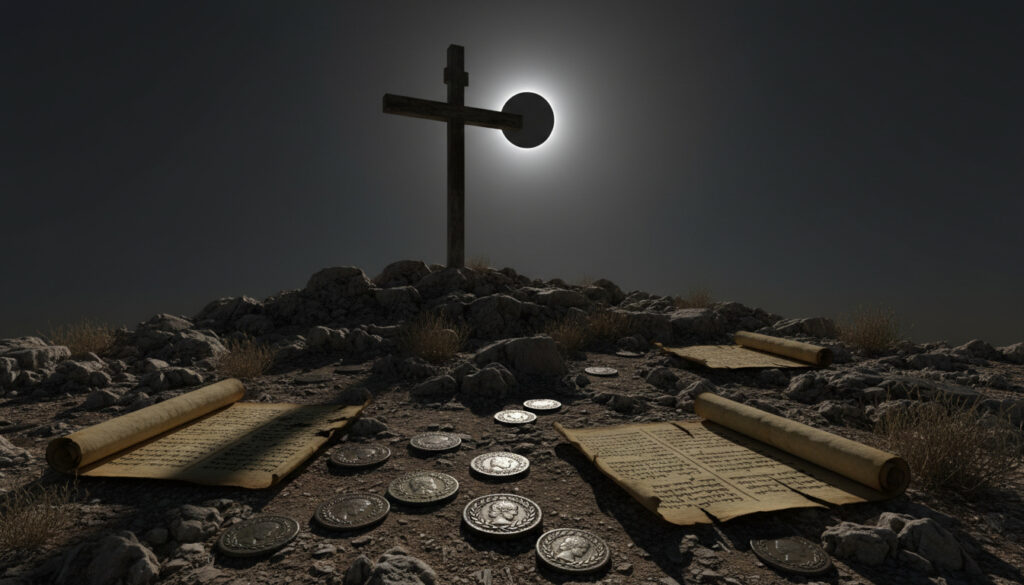
The partial lunar eclipse visible on April 3, AD 33, mentioned by the historian Phlegon in his Chronicles (Olympiad 202), potentially corresponds to the “moon turned to blood” imagery in Acts 2:20. While not definitive proof, this astronomical marker provides external chronological support for the AD 33 dating.
How Old Was Jesus and Where Did He Die?
Luke 3:23 states that Jesus was “about thirty years old” when he began his ministry. With a ministry spanning at least three Passovers according to John’s Gospel, this places his age at death around 33, though the text never explicitly states this figure. Did Willie Nelson Pass Away – No, Alive at 92 with Grammy Nods
The execution occurred at Golgotha, Aramaic for “place of the Skull,” located outside Jerusalem’s walls according to John 19:17. Archaeological evidence and early church tradition identify this as a limestone quarry area near the modern Church of the Holy Sepulchre. The Romans typically crucified victims along major roads to maximize public visibility, consistent with this location’s proximity to ancient thoroughfares.
What Was the Timeline of Jesus’s Final Days?
- Thursday Evening: The Last Supper and arrest in Gethsemane. Matthew 26:20-56
- Thursday Night: Jewish trials before Annas and Caiaphas; Peter’s denials. Mark 14:53-72
- Friday Morning: Roman trial before Pontius Pilate; scourging and sentencing. Luke 23:1-25
- Friday 9 AM: Crucifixion begins at Golgotha. Mark 15:25
- Friday 12 PM: Darkness covers the land for three hours. Matthew 27:45
- Friday 3 PM: Death at the ninth hour. Mark 15:34-37
- Friday Evening: Burial in Joseph of Arimathea’s tomb before Sabbath. John 19:38-42
What Is Certain and What Remains Unclear?
| Established Information | Uncertain Elements |
|---|---|
| Crucifixion occurred during Pontius Pilate’s governorship (AD 26-36) | Precise year: AD 30 versus AD 33 remains debated |
| Death occurred on a Friday before or during Passover | Exact hour: “ninth hour” represents an approximation |
| Location was Golgotha outside Jerusalem | Specific date in April remains disputed |
| Execution method was Roman crucifixion | Age at death: ~33 is an inference, not explicit |
| Three Passovers occurred during ministry | Harmonization of Synoptic and Johannine chronologies |
Historical and Cultural Context
The dating of Jesus’s death requires understanding ancient calendrical systems. The Jewish calendar operated on lunar months, with Passover (Nisan 14/15) falling on the first full moon after the vernal equinox. Historical records indicate that Jewish authorities sometimes adjusted festival dates based on agricultural observations, introducing additional variables into precise date calculations.
Passover commemorated the Israelite exodus from Egypt, making it a politically charged time in Roman-occupied Judea. The Gospels note that Caiaphas and Pilate feared riots, explaining the hurried trials and execution. This historical context supports the Gospel accounts of expedited legal proceedings unusual for typical capital cases.
What Do Historical Sources Say About Jesus’s Death?
Christus, from whom the name had its origin, suffered the extreme penalty during the reign of Tiberius at the hands of one of our procurators, Pontius Pilatus.
— Tacitus, Annals 15.44, c. AD 116
Pilate, at the suggestion of the principal men amongst us, condemned him to the cross.
— Josephus, Antiquities of the Jews 18.3.3, c. AD 93-94
And when the sixth hour had come, there was darkness over the whole land until the ninth hour.
— Mark 15:33, ESV
Summary
The crucifixion of Jesus occurred on a Friday between AD 30 and AD 33, most likely April 7, AD 30, or April 3, AD 33, during Passover under Pontius Pilate. While astronomical and historical evidence supports specific dates within this range, the exact year remains subject to scholarly debate based on Gospel harmonization and calendrical interpretations. Flea (Musician) – RHCP Bassist Biography and Facts
Frequently Asked Questions
Did Jesus die on Friday?
Yes, all four Gospels agree Jesus died on Friday, termed the “day of Preparation” before the Sabbath. This consensus aligns with the historical requirement to bury bodies before sunset.
What calendar was used for Jesus death date?
The Julian calendar was in use during Jesus’s lifetime. The Gregorian calendar, introduced in 1582, differs by 10-13 days. Jewish lunar months determined Passover timing.
Was Jesus crucified on Passover?
The Gospels vary: Synoptics suggest during Passover, John suggests the day before. Both agree it occurred during the Passover festival period in spring.
How do we know Jesus died in AD 30 or 33?
Calculations based on Pontius Pilate’s governorship (AD 26-36), Tiberius’s reign, and lunar eclipse data narrow the possibilities to these two years, with AD 30 holding majority support.
Where exactly was Jesus crucified?
At Golgotha, “the place of the Skull,” outside Jerusalem’s walls. Tradition and archaeology point to the site near the Church of the Holy Sepulchre.
What time did Jesus die?
Biblical accounts indicate the ninth hour, or 3 PM Jewish time, following six hours on the cross beginning around 9 AM.
More related posts
 What Does Pansexual Mean – Definition, Differences and Facts
 9-1-2001: 9/11 Attacks – Youngest Victim & Survivors
 Tsunami Warning Today Live – Current Status & Alerts
 Jason Kelce Super Bowl Wins: 1 Ring (LII) Details
 Where to Watch The Grinch (2025) – All 3 Versions
 O Positive Blood Type: Facts, Benefits, and Common Questions
 90 Days From Today – Calendar and Business Days Guide