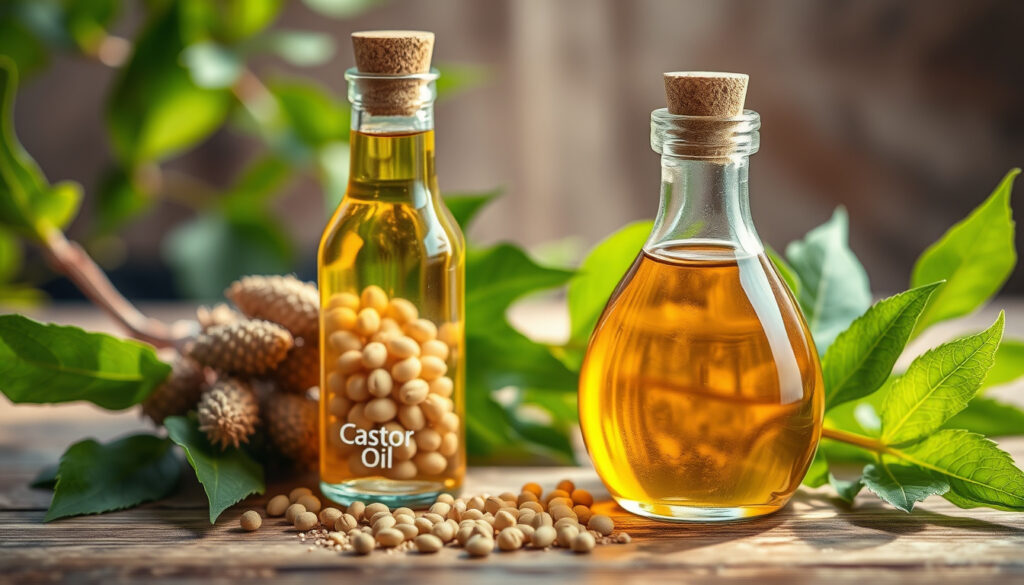
Benefits of Castor Oil: Evidence-Based Uses and Safety
Few kitchen staples have a history as long — or as confidently overstated — as castor oil, yet regulators approve it only for short-term constipation relief. This guide separates what the evidence supports from what remains wishful thinking.
Ricinoleic acid content: 90% of fatty acids ·
FDA status: Generally Recognized as Safe (GRAS) for laxative use ·
Historical use: Ancient Egypt, India, and Greece ·
Common modern uses: Laxative, moisturizer, hair treatment, pain relief
Quick snapshot
- FDA-approved as a stimulant laxative for occasional constipation — StatPearls (NCBI Bookshelf)
- Safe external moisturizer for most skin types — Cleveland Clinic Health Essentials
- Anti-inflammatory properties in laboratory studies — PMC narrative review (peer-reviewed dermatology journal)
- Hair growth promotion and labor induction — both lack strong clinical evidence — WebMD (health information publisher)
- Belly button application for systemic benefits — no robust evidence — NY Presbyterian Health Matters (health system)
- Used in Ancient Egypt, India, and Greece; FDA GRAS for OTC laxative use — EMA HMPC (European regulatory body)
- Modern cosmetic use surged via social media since 2010s — MedicineNet (health information publisher)
- More clinical trials needed for hair growth claims — Hairlossable (specialist hair loss site)
- Regulatory scrutiny and consumer education on safe dosing — Marketing or Science (industry analysis)
Here’s a quick reference for castor oil’s key properties.
| Property | Detail |
|---|---|
| Active Compound | Ricinoleic acid (monounsaturated fatty acid) |
| Traditional Use | Ancient Egypt, Ayurveda, Traditional Chinese Medicine |
| Modern Regulation | FDA GRAS for over-the-counter laxative use |
| Common Forms | Cold-pressed oil, castor oil packs, capsules |
What are 10 benefits of castor oil?
What are the main chemical components of castor oil?
- Ricinoleic acid — a monounsaturated fatty acid that makes up about 90% of the oil’s fatty acid content (StatPearls (NCBI Bookshelf)).
- Vitamin E and other antioxidants — contribute to its moisturizing and anti-inflammatory properties (PMC narrative review (peer-reviewed dermatology journal)).
- Omega-9 fatty acids — support skin barrier function.
Castor oil’s unique chemistry is why it works: ricinoleic acid binds to receptors in the gut to trigger contractions, making it an effective laxative. On the skin, that same fatty acid acts as a humectant and anti-inflammatory agent.
The dominant compound determines the dominant effect. For the gut, that means stimulation. For the skin, it means moisture and mild inflammation control — two very different outcomes from the same molecule.
What does scientific research say about castor oil?
- Laxative use — well-established. The European Medicines Agency HMPC concluded castor oil can be used short-term for occasional constipation based on 10+ years of bibliographic evidence (EMA HMPC (European regulatory body)).
- Anti-inflammatory effects — demonstrated in lab studies, but human trials remain limited (PMC narrative review).
- Hair growth — “There is no scientific evidence that castor oil promotes hair growth,” reports WebMD (WebMD).
- Moisturizing — effective as an occlusive, but may clog pores for acne-prone skin (Cleveland Clinic Health Essentials).
The pattern: the research is strongest for the one use regulators approve, and drops off sharply for cosmetic claims. Consumers should calibrate expectations accordingly.
What happens if you rub castor oil on your belly?
When you rub castor oil on your belly, it absorbs through the skin and may reduce local inflammation. The practice is often used in castor oil packs for digestive discomfort and menstrual cramps.
Why do people put castor oil in their belly button before bed?
- Ayurvedic tradition — the belly button (navel) is considered a center for connecting internal organs. Applying oil there is thought to nourish tissues (NY Presbyterian Health Matters).
- No robust evidence — no clinical studies confirm systemic health benefits from this practice (WebMD).
The belly button has thin skin that absorbs oil readily, but that doesn’t mean it reaches your liver or digestive organs. Traditional uses ≠ proven mechanism.
Benefits of castor oil in belly button
- Moisturizes the skin in that area.
- May reduce dryness or irritation.
- Some users report relief from bloating (anecdotal).
These reported benefits are largely anecdotal. They carry low scientific weight, but the practice is generally safe for intact skin.
How to take castor oil to cleanse stomach
- Dosage: Adults can take 1–2 teaspoons (5–10 mL) orally, preferably on an empty stomach (StatPearls).
- Timing: Effects occur within 6–12 hours. Do not take at night before bed if bowel movement is inconvenient.
- Duration: Use only for occasional constipation, not daily. Long-term use can cause dehydration and electrolyte loss (Cleveland Clinic Health Essentials).
- Safety: Do not take if you have abdominal pain, nausea, or vomiting. Consult a doctor before use if you are pregnant or have a medical condition (EMA HMPC).
What this means: oral castor oil works for temporary constipation relief, but it’s a tool, not a habit. The FDA and EMA both limit use to short-term — the “cleanse” narrative overstates it.
What happens if I leave castor oil on my face overnight?
Leaving castor oil on your face overnight can work as a moisturizer, but it carries risks depending on your skin type.
What are the disadvantages of applying castor oil on the face?
- Comedogenic risk: Castor oil has a comedogenic rating of 1 (low risk), but it can still clog pores for acne-prone skin (Cleveland Clinic Health Essentials).
- Allergic reactions: Redness, itching, and swelling have been reported (PMC narrative review).
- Hair felting risk: On the face near hairline, castor oil can cause hair to tangle severely (WebMD).
Benefits of castor oil on face
- Deeply moisturizes dry, cracked skin.
- May reduce fine lines due to fatty acid content.
- Can soothe minor irritations and inflammation.
Always do a patch test on inner arm before applying to face. Use a thin layer — no more than a few drops — and rinse off after 30 minutes for the first few applications.
The trade-off: castor oil works as an occlusive moisturizer, but for anyone with oily or acne-prone skin, the risk of breakouts may outweigh the hydration benefits.
Where is the best place to put castor oil on your body?
The best places depend on your goal: scalp for potential hair benefits, joints for pain, or dry patches for moisture. Safety matters more than location.
Where should you not put castor oil?
- Eyes — can cause severe irritation and blurred vision.
- Inner ears — may block the ear canal or cause inflammation.
- Mucous membranes (mouth, nose, genitals) — highly irritating.
- Open wounds or broken skin — risk of infection and delayed healing (Cleveland Clinic Health Essentials).
How to use castor oil for pain relief
- Castor oil packs: Soak a flannel cloth with castor oil, place it on the painful area (e.g., joints, lower back), cover with plastic wrap, and apply a heat source (warm water bottle or heating pad) for 20–30 minutes (WebMD).
- Direct massage: Warm a few drops of castor oil in your hands and massage into sore muscles or arthritic joints (NY Presbyterian Health Matters).
- Frequency: Use 2–3 times per week. Discontinue if irritation occurs.
The pattern: pain relief evidence is largely anecdotal. Ricinoleic acid does show anti-inflammatory effects in lab studies, but large-scale human trials are missing. For chronic pain, castor oil packs can complement — not replace — medical treatment (PMC narrative review).
How to use castor oil for pain relief
Castor oil packs and massages are the two most common methods. Both rely on the oil’s absorption through skin.
Castor oil packs for pain
- Materials needed: Castor oil, flannel cloth, plastic wrap, heat source.
- Application: Soak cloth, apply to affected area, cover with plastic, apply heat for 20–30 minutes.
- After: Wash skin with warm water and mild soap. Store cloth in sealed container for reuse (WebMD).
Castor oil for arthritis and joint pain
- Mechanism: Ricinoleic acid may reduce inflammation in joints (PMC narrative review).
- User reports: Many users claim relief from osteoarthritis and rheumatoid arthritis symptoms, though no large-scale human trials confirm this.
- Safety: Safe for external use on intact skin. Always do a patch test first (Cleveland Clinic Health Essentials).
“Castor oil is a powerful stimulant laxative that should only be used short-term.”
— Dr. Michael F. Picco, Mayo Clinic (gastroenterology specialist)
“Castor oil is a great occlusive moisturizer, but it can be comedogenic for acne-prone skin.”
— Dr. Whitney Bowe, board-certified dermatologist
The implication: The experts agree on what castor oil does well (constipation relief, moisture occlusion) and what it doesn’t (hair growth, systemic detox). The claims that survive scrutiny are the ones with regulatory backing.
Frequently asked questions
Can castor oil be used for eyelashes?
Yes, some people apply castor oil to eyelashes to moisturize and potentially strengthen them. However, no clinical studies confirm it promotes lash growth. Avoid contact with eyes. If irritation occurs, discontinue use (WebMD).
Is castor oil safe for acne-prone skin?
It can be — but with caution. Castor oil has a comedogenic rating of 1 (low risk), but it’s still oil-based. For acne-prone skin, use sparingly as a spot treatment or mix with a non-comedogenic carrier oil like jojoba. Always patch test first (Cleveland Clinic Health Essentials).
How long does it take for castor oil to work on hair?
There is no scientific evidence that castor oil promotes hair growth. If used as a moisturizer, you may notice softer, shinier hair after a few washes. For growth claims, don’t expect results — no human trial supports them (WebMD).
Does castor oil help with stretch marks?
Castor oil may moisturize the skin, making stretch marks appear less prominent temporarily. But no clinical evidence shows it reduces or prevents stretch marks. Consistent moisturizing with any emollient can help skin elasticity (Cleveland Clinic Health Essentials).
Can you use castor oil on dogs?
Topical use on dogs is generally safe — it can moisturize dry paws or minor skin irritations. Never let dogs ingest castor oil. Consult a veterinarian before use (NY Presbyterian Health Matters).
What is the best castor oil brand?
Look for 100% pure, cold-pressed, hexane-free castor oil in dark glass bottles. Organic certification is a plus. Popular brands include Heritage Store, NOW Foods, and Sky Organics. Avoid oils with added ingredients for cosmetic use (WebMD).
Is castor oil good for dry scalp?
Yes, castor oil can moisturize a dry, flaky scalp due to its high fatty acid content. Apply a few drops, massage in, and leave for 30 minutes before washing. Avoid overuse, as it can clog scalp pores (Cleveland Clinic Health Essentials).
Does castor oil expire? How to store it?
Yes, castor oil typically lasts 2–5 years. Store in a cool, dark place away from heat and sunlight. Do not refrigerate. If it smells rancid or changes texture, discard it (NY Presbyterian Health Matters).
For more on natural remedies, read our article on Ashwagandha Benefits for Women: Stress, Hormones & Safety and Is Canola Oil Bad for You? Facts, Risks, and Comparisons.
More related posts
 Topamax Ruined My Life? Side Effects & Withdrawal Guide
 Ben Foster (Actor) Biography: Movies and Relationships
 The Substance: Where to Watch Streaming & Rental Guide
 2026 Toyota Corolla Cross – Price, Specs and Release Details
 What Does RSVP Stand For – Meaning, Origin and Etiquette
 Is Canola Oil Bad for You? Facts, Risks, and Comparisons
 White Chicken Chili Recipe – Ingredients & Pro Tips