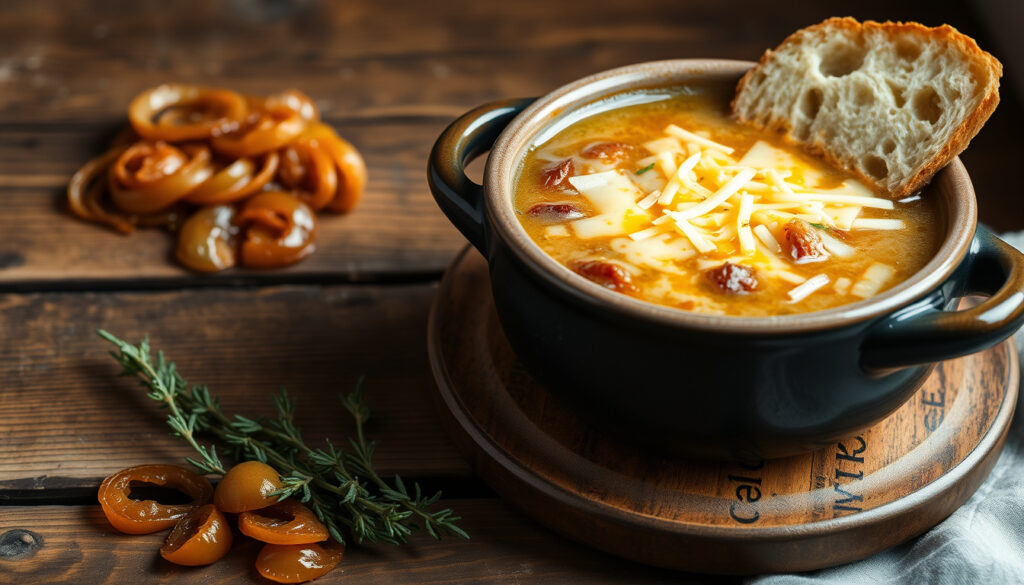
French Onion Soup Recipe – Step by Step with Secret Tips
There’s something deeply satisfying about a bowl of French onion soup — that rich, dark broth under a blanket of bubbly, golden cheese. But if you’ve ever tried making it at home, you know the real challenge isn’t the ingredient list; it’s coaxing those onions to that perfect, deep caramel color without burning them.
Total cook time: Approx. 70-90 minutes ·
Main ingredient: Onions (typically 4-5 large) ·
Broth base: Beef or vegetable stock ·
Cheese topping: Gruyère or Comté ·
Classic serving: In a ramekin with toasted baguette
Quick snapshot
- Use whole Gruyère, grate fresh
- Toast baguette slices before topping
- Broil until cheese is bubbly
- Let soup rest 2-3 minutes after broiling
- Serve with extra thyme or parsley
- Pair with a green salad for a full meal
Step-by-step method
- Caramelize onions slowly in butter and oil over medium-low heat for 40–60 minutes, stirring every 5 minutes, until deep golden brown.
- Deglaze the pot with dry white wine, vermouth, or stock, scraping up the browned fond; repeat 2–3 times.
- Add beef or vegetable stock, fresh thyme, bay leaf, and simmer for 20–30 minutes. Season with salt and pepper.
- Toast baguette slices until crisp.
- Ladle soup into oven-safe bowls, top with toasted bread and a generous layer of freshly grated Gruyère, then broil 1–2 minutes until bubbly and golden.
Four key facts about this recipe’s ingredient proportions, one pattern: the ratio of onions to broth to cheese determines whether you get a balanced soup or an overly rich one.
| Ingredient | Value |
|---|---|
| Number of onions | 4-5 large (about 1 kg / 2.2 lb) |
| Typical soup yield | 4-6 servings |
| Most recommended stock | Beef broth (low-sodium) |
| Caramelization time | 40–60 minutes |
What is the secret to a good French onion soup?
Caramelize slowly on medium-low heat
The single most important factor in a great French onion soup is the patience you bring to the first step: caramelizing the onions. BBC Food, a trusted UK culinary authority, states that the onions should be cooked over medium-low heat until an even rich brown caramel color — a process that takes at least 40 minutes. Rushing this step means you get bitter, unevenly cooked onions instead of that sweet, deep flavor.
Using a heavy-bottomed pot prevents hot spots. Emeril Lagasse, the celebrated chef, emphasizes that a wider pot surface increases onion contact with heat and encourages even caramelization.
Home cooks who rush caramelization on high heat face a predictable outcome: burnt sugars, bitter flavor, and a soup that tastes acrid rather than sweet. The 40-minute low-heat rule isn’t optional — it’s the single point where success or failure is decided.
Use a mix of butter and oil
Most authoritative recipes call for a dual-fat approach. Emmi USA, a Gruyère specialist, recommends cooking onions in both butter and oil. Butter adds flavor, while oil prevents the butter from burning during the long caramelization window. BBC Food also uses this combination in its Gruyère croûton version.
Deglaze the pot properly
After your onions reach a deep golden brown, you’ll notice a sticky brown layer — called the fond — on the bottom of your pot. BBC Food describes scraping these browned bits when adding liquid, which builds concentrated flavor in the finished broth. Deglaze with wine, dry vermouth, or stock, and repeat 2-3 times if your pot allows.
The implication: the fond is pure flavor. Skipping the deglaze step means losing the most concentrated onion taste your pot will produce.
What is the secret ingredient in French onion soup?
Dry vermouth or brandy (Jamie Oliver)
Jamie Oliver, the renowned British chef, uses dry vermouth or brandy as the optional secret liquid in his French onion soup. A splash added during deglazing introduces herbal complexity that plain wine can’t match. BBC Food’s recipe similarly adds white wine, flour, brandy, and sherry before stock — a richer, more fortified style than simpler versions.
Fresh thyme and bay leaf
While a single “secret ingredient” makes a good headline, the real flavor builder is a bundle of fresh herbs. Williams Sonoma, a premium kitchenware retailer, incorporates white wine, sherry, stock, and thyme in its slow-cooker adaptation, reflecting a layered modern restaurant-style approach. A few sprigs of fresh thyme and a bay leaf simmered in the broth add an earthy depth that aromatics alone can’t provide.
Gruyère cheese for the gratinée
The cheese topping isn’t just decoration — it’s a functional ingredient. Emmi USA notes that Gruyère melts smoothly and browns well under a broiler, creating that signature crackling crust. BBC Food griddles bread before topping the soup, then grills the cheese until bubbling and golden.
A single “secret ingredient” like vermouth adds complexity, but the real flavor depth comes from layering multiple small choices — a quality stock, fresh herbs, and properly aged cheese. No single bottle can rescue rushed caramelization.
What ingredients are in French onion soup?
Onions (yellow or white)
Start with 4-5 large yellow or white onions, roughly 1 kg or 2.2 lb. Yellow onions have the best balance of sugar and water content for caramelization, according to multiple recipe sources.
Butter and olive oil
As noted, both fats work together. BBC Food and Emmi USA both use this double-fat foundation.
Beef or vegetable stock
Most recipes call for beef stock as the traditional base. BBC Food uses beef stock and optional sherry. For vegetarians, a high-quality vegetable stock works, though the broth will be lighter in body.
Dry vermouth or white wine (optional)
A splash of dry white wine or vermouth adds acidity that balances the sweet caramelized onions. Williams Sonoma’s slow-cooker version uses both white wine and sherry.
Thyme, bay leaf, salt, pepper
Simple seasonings go a long way. A bundle of fresh thyme and one bay leaf simmered for 20-30 minutes infuses the broth with herbal notes.
Baguette slices
Stale or day-old baguette works best — it soaks up broth without disintegrating. Toast the slices before topping to prevent sogginess.
Gruyère or Comté cheese
Emmi USA emphasizes using whole Gruyère, freshly grated. Pre-shredded cheese contains anti-caking agents that prevent smooth melting.
The pattern: this ingredient list is deliberately short and flexible. The magic isn’t in exotic items — it’s in using quality versions of each component and cooking each step properly.
What are some common mistakes when making French onion soup?
Cooking onions on too high heat
This is mistake number one. RecipeTin Eats, a widely trusted recipe blog, warns that high heat burns sugars before full caramelization occurs. The result is bitter, unevenly cooked onions that can’t be fixed later.
Skipping the deglazing step
The browned bits stuck to the pan after caramelization are pure flavor. Deglazing with broth or wine after browning is essential to incorporate that flavor into the soup, as BBC Food demonstrates.
Using pre-shredded cheese
Pre-shredded cheese is coated with cellulose to prevent clumping, which means it doesn’t melt into a smooth, stretchy layer. Emmi USA and other sources all agree: grate your Gruyère fresh for the best texture and browning.
Underseasoning the broth
Caramelized onions are sweet, but the broth needs salt and pepper to balance that sweetness. Taste the broth before adding the bread and cheese — it should be savory and well-seasoned, not flat.
The most expensive Gruyère won’t save a soup made with bitter, burned onions. Conversely, a humble supermarket stock can work beautifully if the caramelization and deglaze steps are executed well. Prioritize technique over ingredient upgrades.
How does Gordon Ramsay make French onion soup?
He uses a heavy-bottomed pot
Gordon Ramsay, the celebrity chef, stresses using a heavy-bottomed pot to distribute heat evenly. His recipe follows the same principle as Emeril Lagasse’s — even heat prevents burning.
He deglazes with brandy
Ramsay deglazes his caramelized onions with brandy, adding depth and a subtle sweetness that complements the beef stock. This mirrors Jamie Oliver’s use of brandy or vermouth as a flavor booster.
He finishes under the broiler
The final step in Ramsay’s approach is to ladle the soup into oven-safe bowls, top with toasted bread and grated Gruyère, then broil until the cheese is bubbly and golden. Emmi USA recommends broiling for 1 to 2 minutes for that perfect crust.
The catch: celebrity chef variations differ mostly in the alcohol used for deglazing (brandy vs. vermouth vs. sherry) and the choice of cheese. The core technique of slow caramelization + deglaze + broil is identical across all of them. No secret trick replaces the base method.
Confirmed facts
- Slow caramelization is essential to avoid bitterness (BBC Food, Jamie Oliver)
- Gruyère is the most common cheese (multiple sources)
What’s unclear
- Whether adding a pinch of sugar is necessary or just a shortcut
- Whether vermouth vs. brandy produces a significantly different taste
“Cook the onions for 45 minutes to an hour over medium-low heat until they are deeply brown and caramelized. Patience here is what separates a good soup from a great one.”
— Emmi USA
“The secret to great French onion soup is the slow cooking of the onions. Don’t rush them — give them the time they need to develop that deep, sweet flavor.”
“Slow cook the onions on low for 10 hours, then on high for 1 to 2 hours if needed. The result is a soup with remarkably deep caramelized flavor.”
After all the technique discussion, one truth emerges: the choice between a 40-minute stovetop caramelization and a 10-hour slow-cooker adaptation is about convenience, not quality. Both can produce excellent soup if the onions are allowed to develop properly. For the home cook on a weeknight, the stovetop method wins on speed. For a weekend project, the slow cooker delivers hands-off depth. Neither path shortcuts the fundamental requirement of time.
youtube.com, youtube.com, bbc.co.uk, facebook.com, thehungrybluebird.com, youtube.com
Frequently asked questions
Can I freeze French onion soup?
Yes, but freeze the soup base without the bread and cheese topping. The toasted bread and melted cheese don’t reheat well. When you’re ready to serve, thaw the soup, reheat, then add fresh bread and cheese before broiling.
What wine should I use in French onion soup?
Dry white wine is traditional, but dry sherry, vermouth, or brandy are also popular. BBC Food uses white wine and sherry. Avoid sweet wines, which can make the soup cloying.
How do I store leftover French onion soup?
Store the soup base in an airtight container in the refrigerator for up to 4 days. Keep the cheese-topped bread separate and assemble only when reheating, to avoid soggy bread.
Can I use red wine instead of white wine?
You can, but the flavor will be different — red wine adds tannin and a deeper color. Most classic recipes use white wine or sherry for a lighter, clearer broth. If using red, choose a dry, medium-bodied wine.
Is French onion soup gluten-free?
Not traditionally, because it uses a flour-thickened broth and bread. However, you can make it gluten-free by substituting the flour with a gluten-free blend and using gluten-free bread for the topping.
Can I make French onion soup in a slow cooker?
Yes. Williams Sonoma offers a slow-cooker version that caramelizes onions on low for 10 hours, then finishes on high for 1-2 hours. The flavor is excellent, though the texture differs from the stovetop method.
What type of onion is best for French onion soup?
Yellow onions are the standard choice for their balanced sugar content and mellow flavor when cooked. White onions work too but can be sharper. Avoid red onions, which can turn an unappealing color.
Can I skip the cheese for a dairy-free version?
Yes, but you’ll lose the signature gratinée crust. For a dairy-free alternative, try a vegan Gruyère-style shred that melts well, or skip the bread and cheese entirely and serve the soup as a rich onion broth with croutons.
For the home cook in 2025, the decision is straightforward: invest the 40-60 minutes in proper caramelization, or accept a thinner, less complex soup. The good news is that the margin for error is forgiving if you keep the heat low and stir often. You can use supermarket ingredients and still produce a bowl that rivals a bistro’s. The only non-negotiable is time.
More related posts
 Tommy Lee Jones Filmography: Career and Key Movies
 Nintendo Switch Pro Controller: Worth It? (2025 Guide)
 Talamasca the Secret Order – Origins, Members and AMC Series
 Translate German to English: Tools, Mistakes, Phrases
 Rick and Morty Season 8: Release Date, Episodes, Where to Watch
 Mary J. Blige’s Real Love Movie: Cast, Watch, Sequel Info
 When Is Presidents Day – Dates 2025-2030, History & Facts
 March Madness Bracket 2025: All No. 1 Seeds Final Four