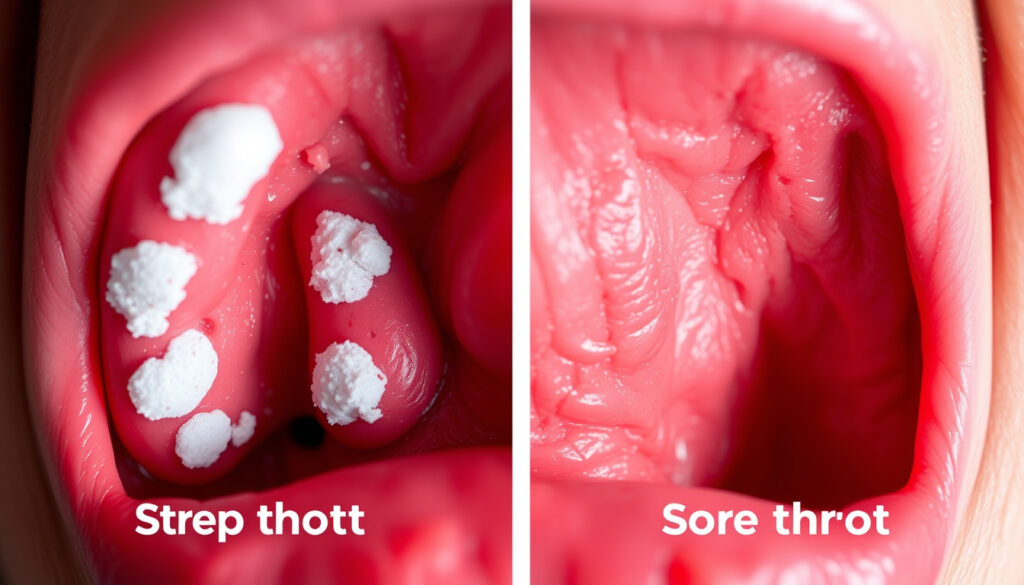
What Does Strep Throat Look Like? Vs Sore Throat Symptoms
That scratchy feeling at the back of your throat might just be a cold—or it could be something that needs antibiotics. Telling the difference matters, because strep throat is caused by bacteria while most sore throats are viral and clear up on their own.
Key visual sign: White patches or streaks on red, swollen tonsils · Common companion symptom: Fever over 101°F · Distinguishing feature: Tiny red spots on roof of mouth · Typical duration untreated: 3-7 days · Contagious period: Up to 2-3 weeks without antibiotics
Quick snapshot
- White patches on tonsils are a hallmark visual marker (GoHealth Urgent Care)
- Strep onset is sudden, not gradual (Liv Hospital)
- Cough is typically absent in strep throat (Covenant Health)
- Visual appearance varies by individual immune response
- Exact contagious duration can differ based on treatment response
- UC Davis Health published updated guidance on strep vs sore throat (UC Davis Health, December 2024)
- Viral sore throats typically resolve in 5-7 days without treatment (UC Davis Health)
- Testing with rapid strep test or culture confirms diagnosis
- Antibiotics reduce contagious period to 24 hours
Key facts at a glance
| Factor | Detail |
|---|---|
| Caused by | Group A Streptococcus bacteria |
| Incubation | 2-5 days |
| Contagious until | 24 hours on antibiotics |
| Test accuracy | Rapid test 70-90%; culture 95% |
| Complication risk | Rheumatic fever if untreated |
The pattern across these facts points to a bacterial infection that demands targeted treatment, not just symptom management.
Can you visually identify strep throat?
A quick look in the mirror with a flashlight can reveal clues. The Cleveland Clinic notes that strep throat shows distinctly different signs from a common cold, especially in the throat itself.
Classic appearance on tonsils
- Red and swollen tonsils deeper red than surrounding tissue
- White patches, spots, or pus streaks visible on tonsils
- Tonsils may appear enlarged and feel tender
Spots in the mouth
- Tiny bright red spots (petechiae) on the roof of the mouth
- Red bumps or streaks at the back of the throat
- Swollen, reddened uvula
Differences by age
- Children may develop abdominal pain alongside throat symptoms
- Scarlet fever rash (sandpaper texture) can appear on neck and chest in children
- Adults often show more subtle swelling with sharper pain on swallowing
In adults, strep throat typically shows red swollen tonsils with white patches, fever above 101°F, and sharp pain when swallowing. Adults may have fewer systemic symptoms like rash compared to children, but swollen lymph nodes in the neck are common. Children with strep throat may show bright red throats, white patches on tonsils, and sometimes a “strawberry tongue” appearance. Abdominal pain and nausea are more common in children. Scarlet fever rash can also appear on the neck and chest.
A Cleveland Clinic physician notes: “If you develop a sudden sore throat and aren’t coughing or sneezing, there’s a good chance it’s strep.” The absence of upper respiratory symptoms combined with visible white patches on red tonsils is the strongest visual combination to watch for.
How can I tell if my sore throat is strep?
The Covenant Health highlights that cough presence is one of the clearest differentiators—strep throat typically lacks a cough, while viral sore throats often come with one.
Strep vs viral sore throat visuals
- Strep: discrete white patches on tonsils; viral: diffuse redness without patches
- Strep: tiny red spots on palate; viral: generally clear oral cavity
- Strep: swollen uvula with possible white/yellow patches
Fever and other signs
- Strep fever typically exceeds 101°F
- Viral sore throat fever is usually low-grade or absent
- Swollen lymph nodes in the front neck point toward strep
When to test
- Sudden onset sore throat with fever above 100.4°F warrants testing
- Rapid strep tests provide results in minutes
- Throat culture offers 95% accuracy when rapid test is negative
If you have a cough, runny nose, or hoarseness alongside your sore throat, bacterial strep is less likely—these upper respiratory symptoms typically indicate a viral cause instead.
According to Cleveland Clinic, viral sore throats resolve in 5-7 days without antibiotics, while strep requires antibiotic treatment to prevent complications including rheumatic fever.
What could be mistaken for strep throat?
Several conditions share visual features with strep throat. The WebMD guide on strep throat provides a helpful exclusion list of symptoms that suggest against bacterial infection.
Common mimics
- Tonsillitis (bacterial or viral)
- Mononucleosis (mono)
- Viral pharyngitis
- Hand, foot, and mouth disease
Visual differences
- White patches in strep are discrete; in viral conditions, they may be absent or diffuse
- Petechiae (tiny red spots on palate) are more characteristic of strep
- Clear runny nose and cough point toward viral causes
Next steps if negative test
- A negative rapid test may be followed by throat culture for confirmation
- If both are negative, your doctor will investigate other causes
- Allergies, acid reflux, and other irritants can cause similar symptoms
When testing comes back negative but symptoms persist, clinicians shift from bacterial to viral or environmental causes—which is why describing what you see in the mirror helps narrow the possibilities.
What does strep throat look like vs sore throat?
The visual differences between these two conditions are striking when you know where to look. Liv Hospital provides detailed comparisons of normal, sore, and strep throats.
Early stage visuals
- Strep: bright red, swollen tonsils appearing within hours
- Viral sore throat: gradual redness developing over several days
Four conditions, one pattern: sudden severe symptoms combined with mouth spots signal bacterial infection.
Tonsil-specific signs
- Healthy tonsils appear pink and moist
- Strep tonsils turn very red with visible white patches or streaks
- Viral tonsils may be slightly red but lack white patches
Mouth and tongue clues
- Petechiae on the roof of the mouth suggest strep
- Swollen uvula is more pronounced in strep cases
- “Strawberry tongue” (red, bumpy surface) can appear in strep, especially in children
These visual markers create a consistent pattern: strep tonsils look distinctly different from healthy tissue, while viral infections rarely produce the discrete white patches that characterize bacterial infection.
Even without tonsils, you can still get strep throat. Dr. Justin McGoldrick (Covenant Health) explains that the infection can affect other areas of the throat when tonsils are absent.
What are 5 symptoms of strep throat?
The Covenant Health medical team outlines the core symptom cluster that defines strep throat presentation.
Top visual symptoms
- Sore throat—often severe and sudden
- White patches on tonsils (pus or exudates)
- Red, swollen tonsils deeper than surrounding tissue
- Tiny red spots on roof of mouth
- Swollen, tender lymph nodes in front of neck
Non-visual flags
- Fever exceeding 101°F
- Headache
- Loss of appetite
- Body aches
Progression over time
- Symptoms appear suddenly within 2-5 days of exposure
- Pain when swallowing worsens without treatment
- Untreated strep typically lasts 3-7 days
These five symptoms together form a recognizable pattern that separates bacterial infection from common viral sore throats—but any combination of these warrants professional testing for confirmation.
According to Cleveland Clinic, if you have a cough, runny nose, or hoarseness alongside your sore throat, bacterial strep is less likely. These upper respiratory symptoms typically indicate a viral cause.
Visual comparison: strep throat vs viral sore throat
Three key differences separate bacterial from viral throat infections, based on appearance and symptom pattern.
| Feature | Strep throat (bacterial) | Viral sore throat |
|---|---|---|
| Tonsil appearance | Red, swollen tonsils with white patches, spots, or pus streaks | Pink or mildly red tonsils without white patches |
| Onset | Sudden, severe within hours | Gradual over several days |
| Fever | Typically above 101°F | Low-grade or absent |
| Cough and cold symptoms | Absent—no cough, runny nose, or sneezing | Present—cough, congestion, runny nose common |
| Mouth spots | Tiny red spots (petechiae) on roof of mouth | Generally clear oral cavity |
| Pain character | Sharp, severe pain when swallowing | Scratchy, mild discomfort |
This side-by-side comparison makes it clear that bacterial and viral infections produce distinctly different visual signatures in the throat and accompanying symptoms.
Confirmed vs unconfirmed: what we know and don’t know
Confirmed
- White patches on tonsils are a diagnostic clue for strep throat (GoHealth Urgent Care)
- Visual identification alone is not 100% accurate—testing is required
- Strep can occur even without tonsils present (Covenant Health)
Reported but unconfirmed
- Severity of visible symptoms may correlate with bacterial load
- Specific visual patterns may vary by individual immune response
What experts say
“If you develop a sudden sore throat and aren’t coughing or sneezing, there’s a good chance it’s strep.”
— Dr. Capin, Cleveland Clinic
“The presence of a cough can help distinguish between sore throat and strep throat. Coughing does not typically accompany strep.”
— Dr. Justin McGoldrick, Medical Affairs Officer, Covenant Health
“A common misconception is that you can’t have strep throat if you don’t have tonsils. Unfortunately, even when your tonsils are removed, it’s still possible to contract the infection in different areas of your throat.”
— Dr. Justin McGoldrick, Covenant Health
For anyone wondering whether their sore throat might be strep, the visual signs are worth checking—but testing remains essential for confirmation. WebMD emphasizes that a negative rapid test should be followed by throat culture when clinical suspicion is high.
Related reading: Toxic Shock Syndrome Symptoms
Frequently asked questions
Does strep throat go away on its own?
Strep throat symptoms typically last 3-7 days without treatment, but the infection usually requires antibiotics to fully resolve and prevent complications like rheumatic fever. Without treatment, you remain contagious for 2-3 weeks.
Is strep throat 100% contagious?
Strep throat spreads easily through respiratory droplets when an infected person coughs or sneezes. With antibiotic treatment, you stop being contagious after 24 hours. Without antibiotics, you can spread the infection for 2-3 weeks.
What does strep throat look like in kids?
Children with strep throat may show bright red throats, white patches on tonsils, and sometimes a “strawberry tongue” appearance. Abdominal pain and nausea are more common in children. Scarlet fever rash (sandpaper texture) can also appear on the neck and chest.
How long does strep throat last?
Without antibiotics, strep throat typically lasts 3-7 days. With proper antibiotic treatment, symptoms usually improve within 1-3 days, and you become non-contagious after 24 hours of treatment.
What does strep throat look like without tonsils?
Even without tonsils, strep throat can affect other areas of the throat. You may see redness and swelling at the back of the throat, white patches on adjacent tissue, or redness of the uvula. Diagnosis relies more on symptoms and testing in tonsillectomized patients.
What drink kills a sore throat fast?
While no drink “kills” a sore throat, warm liquids like honey tea, broth, or warm water with lemon can soothe symptoms temporarily. However, if your sore throat is caused by strep bacteria, only antibiotics will address the root infection.
What does strep throat look like on tongue?
In some cases, especially in children, strep throat can cause “strawberry tongue”—a red, bumpy appearance on the tongue’s surface. White coating may also appear before the tongue turns bright red. This visual sign often accompanies other strep symptoms like fever and swollen tonsils.
For more on related complications, learn about Toxic Shock Syndrome Symptoms.
More related posts
 How to Get Rid of Nausea Fast: Proven Home Remedies
 Salt Fat Acid Heat: The 4 Pillar of Cooking Explained
 Shiba Inu Price Prediction 2026–2040: Will SHIB Reach $1?
 Jack in the Box: History, E. coli Outbreak, Menu & More
 Are Grapes Bad for Dogs? Toxicity, Risks & Symptoms
 All Barbie Movies in Order: Complete List (2001–2022)
 Loans for Bad Credit in Ireland: Best Options & Where to Apply
 Reheat Pizza in Air Fryer – No More Soggy Slices